Pearson+ LogoPearson+ Logo

Eukaryotic Chromosome Structure quiz #1 Flashcards

Back
Eukaryotic Chromosome Structure quiz #1
Control buttons has been changed to "navigation" mode.
1/39
  • Which terms typically apply to eukaryotic chromosomes? Select all that apply: chromatin, nucleosome, heterochromatin, euchromatin, centromere, telomere, supercoiling, histone proteins.

    All of these terms—chromatin, nucleosome, heterochromatin, euchromatin, centromere, telomere, supercoiling, and histone proteins—typically apply to eukaryotic chromosomes. They describe the structure, packaging, and specialized regions of eukaryotic chromosomal DNA.
  • What is the main difference between heterochromatin and euchromatin?

    Heterochromatin is tightly packed chromatin, while euchromatin is loosely packed, allowing for more gene expression.
  • Which histone proteins make up the core of a nucleosome?

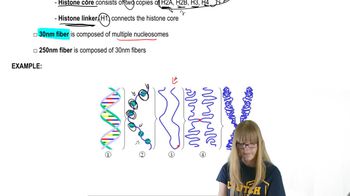
    The nucleosome core consists of two copies each of histone proteins H2A, H2B, H3, and H4.
  • What role does the histone H1 protein play in chromatin structure?

    Histone H1 acts as a linker protein, connecting nucleosome cores and helping further condense the DNA.
  • Describe the packaging progression of eukaryotic chromosomal DNA from nucleosome to chromosome.

    DNA wraps around nucleosomes, which form 30 nm fibers, then condense into 250 nm fibers, ultimately forming the visible chromosome structure.
  • What is the function of the kinetochore in chromosome segregation?

    The kinetochore is a protein complex that attaches centromeres to spindle fibers, ensuring proper chromosome separation during cell division.
  • Which histone variant is uniquely found at centromeres, and why is it important?

    CENH3 is a rare histone variant found only at centromeres, crucial for forming tightly packed heterochromatin and kinetochore attachment.
  • What is the sequence composition and structural feature found at the very end of telomeres?

    Telomeres have repetitive sequences rich in A's, T's, and G's, ending with a G-rich 3' overhang that is single-stranded.
  • How do shelterin proteins contribute to telomere stability?

    Shelterin proteins bind to telomeric repeats, protecting chromosome ends from degradation and maintaining their integrity.
  • What is the difference between positive and negative supercoiling in DNA, and which enzymes resolve these structures?

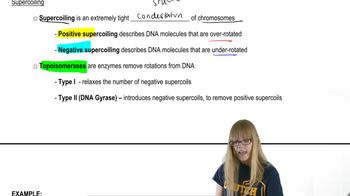
    Positive supercoiling is over-rotated DNA, while negative supercoiling is under-rotated; topoisomerases, including DNA gyrase, resolve these by introducing breaks to relax or tighten the DNA.
  • Where is DNA located in eukaryotic cells?

    In eukaryotic cells, DNA is primarily located in the nucleus.
  • In eukaryotes, nearly all the DNA is found in which cellular compartment?

    Nearly all the DNA in eukaryotes is found in the nucleus.
  • What is the visible structure formed when DNA coils and condenses during cell division?

    When DNA coils and condenses during cell division, it forms visible chromosomes.
  • What is the relationship between DNA and chromosomes in eukaryotic cells?

    Chromosomes are structures composed of DNA and proteins; DNA is packaged into chromosomes to fit within the nucleus.
  • What is the thread-like structure of DNA that carries genes called?

    The thread-like structure of DNA that carries genes is called a chromosome.
  • During interphase, in what form is DNA found in eukaryotic cells?

    During interphase, DNA is found in the form of chromatin, which is less condensed and stringy.
  • What structure in eukaryotic cells contains both DNA and proteins?

    Chromatin is the structure in eukaryotic cells that contains both DNA and proteins.
  • What is uncoiled, stringy DNA called in eukaryotic cells?

    Uncoiled, stringy DNA in eukaryotic cells is called chromatin.
  • What forms a coiled structure of DNA and proteins in eukaryotic cells?

    Chromosomes form a coiled structure of DNA and proteins in eukaryotic cells.
  • Why do histones bind tightly to DNA?

    Histones bind tightly to DNA because they help package and condense the DNA into a compact structure that fits within the nucleus.
  • Why does DNA need to be tightly packed in eukaryotic cells?

    DNA needs to be tightly packed to fit the long DNA molecules into the small space of the nucleus and to regulate gene expression.
  • What is the name for the combination of DNA and proteins in eukaryotic chromosomes?

    The combination of DNA and proteins in eukaryotic chromosomes is called chromatin.
  • What is the basic unit of DNA packaging in eukaryotic chromosomes?

    The basic unit of DNA packaging in eukaryotic chromosomes is the nucleosome.
  • What is the role of histone proteins in chromosome structure?

    Histone proteins help package DNA into nucleosomes, which further condense to form higher-order chromosome structures.
  • What is the difference between heterochromatin and euchromatin?

    Heterochromatin is tightly packed chromatin, while euchromatin is loosely packed chromatin.
  • What is the function of the centromere in a chromosome?

    The centromere is the constricted region of a chromosome where spindle fibers attach via the kinetochore during cell division.
  • What is the function of telomeres in eukaryotic chromosomes?

    Telomeres protect the ends of chromosomes from degradation and aid in replication.
  • What is the repetitive sequence found at the ends of eukaryotic chromosomes called?

    The repetitive sequence at the ends of eukaryotic chromosomes is called the telomeric sequence.
  • What is the unique histone variant found at centromeres?

    The unique histone variant found at centromeres is called CENH3.
  • What is supercoiling in DNA?

    Supercoiling is the over- or under-twisting of DNA, resulting in tension and structural changes.
  • Which enzymes manage DNA supercoiling?

    Topoisomerases are enzymes that manage DNA supercoiling by introducing cuts to relax or tighten the DNA.
  • What is the role of shelterin proteins in chromosome structure?

    Shelterin proteins bind to telomeric sequences and protect chromosome ends from degradation.
  • How are DNA, genes, and chromosomes related in eukaryotic cells?

    Genes are segments of DNA, and DNA is packaged into chromosomes; chromosomes carry many genes.
  • What is the form of DNA during interphase in eukaryotic cells?

    During interphase, DNA is in the form of loosely packed chromatin.
  • What is the function of the kinetochore in chromosome structure?

    The kinetochore is a protein complex that links the centromere to spindle fibers during cell division.
  • What is the difference between naked DNA and chromatin?

    Naked DNA refers to DNA without associated proteins, while chromatin is DNA combined with proteins.
  • Why does DNA need to be coiled in eukaryotic cells?

    DNA needs to be coiled to efficiently package it into the nucleus and to regulate access for gene expression.
  • What is the stringy, uncoiled form of DNA called?

    The stringy, uncoiled form of DNA is called chromatin.
  • How do topoisomerases relieve DNA supercoiling?

    Topoisomerases relieve DNA supercoiling by introducing temporary breaks in the DNA strands to release tension.