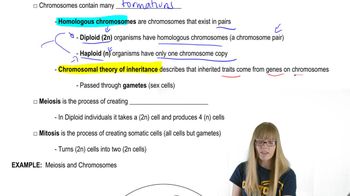
A gene is a stretch of DNA that encodes for a protein.
How many chromosomes are in a typical human cell?
A typical human cell has 46 chromosomes.
What are the four nitrogenous bases in RNA?
The four bases in RNA are adenine (A), uracil (U), cytosine (C), and guanine (G).
What are the definitions for gene pool and allele frequency?
Gene pool is the total collection of alleles in a population; allele frequency is the proportion of a specific allele among all alleles for a gene in a population.
What is the haploid number of chromosomes in humans?
The haploid number in humans is 23 chromosomes.
A human body cell has 46 chromosomes. How many chromosomes does a human egg or sperm cell have?
A human egg or sperm cell has 23 chromosomes.
How many unique gametes could be produced by an individual with the genotype aabbcc?
An individual with the genotype aabbcc can produce only one unique gamete.
Approximately how large is a typical eukaryotic gene?
A typical eukaryotic gene is several thousand base pairs long.
What is an accurate description of genes?
Genes are stretches of DNA that encode for proteins.
For a DNA strand that is two nucleotides long, how many possible sequences are there?
There are 16 possible sequences for a DNA strand two nucleotides long (4^2).
How many chromosomes does an elephant zygote have and how are they inherited?
An elephant zygote has 56 chromosomes, receiving half from each parent.
Which is a synonym for male and female sex cells: gametes, chromosomes, eukaryotes, or diploids?
Gametes is a synonym for male and female sex cells.
If an organism's diploid number is 12, what is its haploid number?
Its haploid number is 6.
How many different sequences of eight bases can you make?
There are 65,536 possible sequences (4^8) of eight bases.
What is another word for heterozygous?
Another word for heterozygous is hybrid.
What is true about autopolyploid individuals?
Autopolyploid individuals have more than two sets of chromosomes, all from the same species.
How many nucleotides are needed to code for a protein with 450 amino acids?
1,350 nucleotides are needed (3 per amino acid).
A DNA molecule containing 32% thymine would contain how much cytosine?
It would contain 18% cytosine.
What is the definition of a genome?
Genome is the complete set of genetic material in an organism.
How can a typical gene be described?
A typical gene is a segment of DNA that encodes a protein.
What are the characteristics of Hox genes? (Check all that apply.)
Hox genes are regulatory genes that control body plan and development.
What is the egg in terms of gametes?
The egg is a female gamete.
Which phrase best describes the term genome?
The genome is the total genetic content of an organism.
Which description is the best definition of a single nucleotide polymorphism?
A single nucleotide polymorphism is a variation at a single base pair in DNA among individuals.
What is the best physical description of a gene?
A gene is a small section of DNA on a chromosome.
Which has the most control of traits and inheritance: gametes, nucleic acids, amino acids, or proteins?
Nucleic acids (DNA) have the most control of traits and inheritance.
What are the phenotypes of an organism?
Phenotypes are the observable characteristics or traits of an organism.
What is the main function of chromosomes in a plant cell?
Chromosomes store and transmit genetic information.
Genetically, what determines an organism's traits?
An organism's traits are determined by its genes and alleles.
How many chromosomes does the human body have?
The human body has 46 chromosomes.
How many chromosome pairs do humans have?
Humans have 23 pairs of chromosomes.
How many pairs of chromosomes are found in each human cell?
Each human cell has 23 pairs of chromosomes.
How many pairs of chromosomes does a human have?
A human has 23 pairs of chromosomes.
Polygenic traits are determined by multiple ______ received from each parent.
Polygenic traits are determined by multiple genes received from each parent.
Gametes must be haploid because ______.
Gametes must be haploid to ensure the correct chromosome number after fertilization.
Human egg and sperm are similar in that ________.
Human egg and sperm are similar in that both are haploid gametes.
The sum of all genetic traits in a population’s individuals at any given time is called the ______.
It is called the gene pool.
Select all of the following that are components of a nucleotide.
A nucleotide consists of a sugar, a phosphate group, and a nitrogenous base.
To have enough DNA for each gamete, the DNA in the germ cell must be ________.
The DNA in the germ cell must be replicated before meiosis.
 Back
Back
 03:45
03:45