In genetics, how does the length of a DNA molecule compare to its width?
DNA is much longer than it is wide; the length of a DNA molecule is thousands to millions of times greater than its width, making it an extremely thin and elongated structure.
What is the difference between a population mean and a sample mean in genetics?
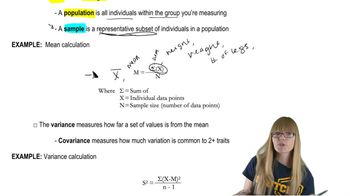
A population mean is the average of all individuals in a group, while a sample mean is the average from a representative subset of that population. The sample mean is used when measuring the entire population is impractical.
Why must scientists be careful when selecting samples to calculate genetic means?
Random samples can sometimes be unrepresentative if, by chance, they include individuals with extreme traits. This can lead to misleading results that do not accurately reflect the population.
How is the mean of a phenotype calculated in a genetic study?
The mean is calculated by summing the measured values of all individuals in the sample and dividing by the number of individuals. This provides the average value for the trait being studied.
What does variance measure in the context of genetic traits?
Variance measures how far individual trait values are from the mean within a population. It quantifies the degree of spread or dispersion in the data.
How does covariance differ from variance when analyzing genetic traits?
Covariance measures how much variation is shared between two traits, while variance measures the spread of a single trait. Covariance helps identify relationships between traits.
What is the relationship between variance and standard deviation in genetic measurements?
Standard deviation is the square root of the variance. Both measure variation, but standard deviation is in the same units as the original data.
What does standard error indicate about a sample mean in genetics?
Standard error measures how accurate the sample mean is as an estimate of the population mean. It accounts for the possibility that the sample may not perfectly represent the population.
How is a normal distribution used to represent genetic variation?
A normal distribution, or bell curve, graphically shows the range and frequency of trait values in a population. It helps visualize how most individuals cluster around the mean and how variation is spread.
What does a narrow bell curve indicate about the variance of a genetic trait?
A narrow bell curve means most individuals have trait values close to the mean, indicating low variance. This suggests little spread or diversity in the measured trait.
 Back
Back

 11:06
11:06