Skip to main content
Genetics
My Course
Learn
Exam Prep
AI Tutor
Study Guides
Textbook Solutions
Flashcards
Explore
Try the app
My Course
Learn
Exam Prep
AI Tutor
Study Guides
Textbook Solutions
Flashcards
Explore
Try the app
Back
Meiosis quiz #4
You can tap to flip the card.
At the end of meiosis, there are how many cells?
You can tap to flip the card.
👆
At the end of meiosis, there are how many cells?
At the end of meiosis, there are four cells.
Track progress
Control buttons has been changed to "navigation" mode.
1/40
Related flashcards
Related practice
Recommended videos
Meiosis quiz #1
Meiosis
40 Terms
Meiosis quiz #2
Meiosis
40 Terms
Meiosis quiz #3
Meiosis
40 Terms
Meiosis
9. Mitosis and Meiosis
7 problems
Topic
Kylia
Development of Animal Gametes
9. Mitosis and Meiosis
4 problems
Topic
Kylia
9. Mitosis and Meiosis
4 topics
10 problems
Chapter
Kylia
Guided course
05:30
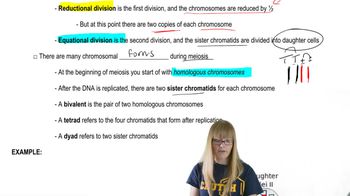
Meiosis Overview
2897
views
38
rank
1
comments
Guided course
09:06
Meiosis Steps
2464
views
20
rank
3
comments
Terms in this set (40)
Hide definitions
At the end of meiosis, there are how many cells?
At the end of meiosis, there are four cells.
Homologous chromosomes separate from each other in which phase?
Homologous chromosomes separate from each other in anaphase I.
Homologous pairs of chromosomes align opposite of each other at the equator of a cell during which phase?
Homologous pairs align at the equator during metaphase I.
In which phase of meiosis would you see sister chromatids move to opposite ends of the cell?
Sister chromatids move to opposite ends during anaphase II.
Meiosis I produces ______ cells, and meiosis II produces ______ cells.
Meiosis I produces two haploid cells; meiosis II produces four haploid cells.
Homologous chromosomes are aligned at the middle of the spindle during which phase?
Homologous chromosomes are aligned at the middle during metaphase I.
Paired homologous chromosomes are found at the center of the cell during which phase of meiosis?
Paired homologous chromosomes are found at the center during metaphase I.
Eukaryotic cells that are diploid can divide by ______ to produce haploid sex cells.
Diploid eukaryotic cells divide by meiosis to produce haploid sex cells.
How many DNA molecules will be found in each cell at the end of anaphase II?
Each cell will have one DNA molecule per chromosome at the end of anaphase II.
The process indicated by the letter _____ produces a diploid structure. (Assume the process is fertilization.)
Fertilization produces a diploid structure (zygote).
After telophase I of meiosis, what is the chromosomal makeup of each daughter cell?
Each daughter cell is haploid with duplicated chromosomes (sister chromatids).
During which phase are the sister chromatids moving apart?
Sister chromatids are moving apart during anaphase II.
Meiosis results in cells. Each of these cells contains how many chromosomes?
Meiosis results in four cells, each with half the original chromosome number.
How many times is PMAT carried out in meiosis?
PMAT is carried out twice in meiosis.
What is the process where a parent cell divides into four sex cells with half the chromosomes?
Meiosis is the process where a parent cell divides into four sex cells with half the chromosomes.
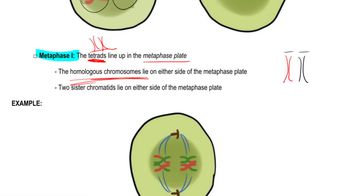
Compare metaphase I and metaphase II in meiosis.
In metaphase I, homologous chromosomes align as tetrads; in metaphase II, sister chromatids align single file.
Separation of homologous chromosomes occurs during which phase?
Separation of homologous chromosomes occurs during anaphase I.
In meiosis, how does prophase I differ from prophase II?
Prophase I involves synapsis and crossing over; prophase II does not.
At the end of anaphase II, how many chromatids are on each side of the cell?
At the end of anaphase II, each side has one chromatid per chromosome.
During which phase does crossing over occur?
Crossing over occurs during prophase I.
After a germ cell replicates and grows in females, it forms two primary what?
It forms two primary oocytes.
What is the process by which haploid cells are produced from diploid cells called?
The process is called meiosis.
One major difference between meiosis I and meiosis II is that?
Meiosis I separates homologous chromosomes; meiosis II separates sister chromatids.
What is the end result of meiosis?
The end result of meiosis is four haploid cells, each with half the genetic material of the original diploid cell.
During which phase of meiosis does crossing over occur?
Crossing over occurs during Prophase I of meiosis.
How many daughter cells are produced in meiosis?
Meiosis produces four daughter cells.
At the end of meiosis II, how many cells are there?
At the end of meiosis II, there are four cells.
What is the end result of meiosis II?
Meiosis II results in four haploid cells, each with one copy of each chromosome.
What is the overall purpose of meiosis?
The overall purpose of meiosis is to produce haploid gametes for sexual reproduction and to ensure genetic diversity.
Meiosis is a process that produces what type of cells?
Meiosis produces haploid cells, specifically gametes such as sperm and egg cells.
What is the final result of meiosis?
The final result of meiosis is four genetically unique haploid cells.
What happens in telophase I of meiosis?
In telophase I of meiosis, chromosomes reach opposite poles, the nuclear membrane reforms, and cytokinesis occurs, resulting in two haploid cells.
In what phase of meiosis does crossing over occur?
Crossing over occurs in Prophase I of meiosis.
Meiosis results in _____?
Meiosis results in four haploid cells.
What phase of meiosis does crossing over occur?
Crossing over occurs during Prophase I of meiosis.
What happens in metaphase II of meiosis?
In metaphase II of meiosis, sister chromatids align at the metaphase plate in each haploid cell.
How many daughter cells are produced in meiosis?
Meiosis produces four daughter cells.
What is the end product of meiosis?
The end product of meiosis is four haploid cells.
Crossing over occurs in which stage of meiosis?
Crossing over occurs in Prophase I of meiosis.
When do sister chromatids separate in meiosis?
Sister chromatids separate during Anaphase II of meiosis.
 BackBack
 05:30
05:30