Skip to main content
Genetics
My Course
Learn
Exam Prep
AI Tutor
Study Guides
Textbook Solutions
Flashcards
Explore
Try the app
My Course
Learn
Exam Prep
AI Tutor
Study Guides
Textbook Solutions
Flashcards
Explore
Try the app
Back
Overview of Genomics definitions
You can tap to flip the card.
Genome
You can tap to flip the card.
👆
Genome
All genetic material in an organism, including coding and non-coding regions, organized within chromosomes.
Track progress
Control buttons has been changed to "navigation" mode.
1/15
Related flashcards
Related practice
Recommended videos
Overview of Genomics quiz #1
Overview of Genomics
11 Terms
Overview of Genomics
15. Genomes and Genomics
3 problems
Topic
Kylia
Sequencing the Genome
15. Genomes and Genomics
7 problems
Topic
Kylia
15. Genomes and Genomics - Part 1 of 2
5 topics
10 problems
Chapter
Kylia
15. Genomes and Genomics - Part 2 of 2
4 topics
10 problems
Chapter
Kylia
Guided course
02:48
Genomics Overview
860
views
6
rank
Terms in this set (15)
Hide definitions
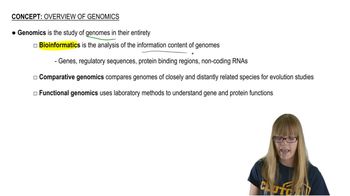
Genome
All genetic material in an organism, including coding and non-coding regions, organized within chromosomes.
Genomics
Field focused on studying entire genetic content, including genes, regulatory elements, telomeres, and centromeres.
Bioinformatics
Discipline analyzing the information-rich portions of genetic material, such as genes and regulatory sequences.
Regulatory Sequence
DNA segment controlling gene activation or inactivation, often serving as binding sites for proteins.
Telomere
Condensed DNA region at chromosome ends, lacking information content but crucial for chromosome stability.
Centromere
Chromosomal region essential for proper segregation during cell division, composed of non-coding DNA.
Comparative Genomics
Approach comparing genetic material across species to reveal evolutionary similarities and differences.
Functional Genomics
Branch dedicated to uncovering gene and protein roles, including expression patterns and biological functions.
Non-coding RNA
RNA molecule transcribed from DNA that does not encode proteins but often regulates gene expression.
MicroRNA
Small non-coding RNA involved in post-transcriptional regulation of gene expression.
siRNA
Short interfering RNA molecule that guides gene silencing by degrading specific messenger RNAs.
Gene Expression
Process determining when, where, and how much a gene's product is produced in an organism.
Protein
Molecule encoded by genes, performing diverse cellular functions such as support, signaling, or secretion.
Chromosome
Structure composed of DNA and proteins, housing the genome and organizing genetic material.
Evolutionary Study
Analysis of genetic material across species to trace lineage relationships and adaptive changes.
 BackBack
 02:48
02:48