Skip to main content
Genetics
My Course
Learn
Exam Prep
AI Tutor
Study Guides
Textbook Solutions
Flashcards
Explore
Try the app
My Course
Learn
Exam Prep
AI Tutor
Study Guides
Textbook Solutions
Flashcards
Explore
Try the app
Back
Proteomics definitions
You can tap to flip the card.
Proteome
You can tap to flip the card.
👆
Proteome
Complete set of proteins present in a cell, tissue, or organism, varying with environmental conditions and timing.
Track progress
Control buttons has been changed to "navigation" mode.
1/14
Related flashcards
Related practice
Recommended videos
Proteomics quiz
Proteomics
15 Terms
Proteomics
15. Genomes and Genomics
6 problems
Topic
Kylia
Functional Genomics
15. Genomes and Genomics
8 problems
Topic
Kylia
15. Genomes and Genomics - Part 1 of 2
5 topics
10 problems
Chapter
Kylia
15. Genomes and Genomics - Part 2 of 2
4 topics
10 problems
Chapter
Kylia
Guided course
06:36
Proteomics
757
views
2
rank
Terms in this set (14)
Hide definitions
Proteome
Complete set of proteins present in a cell, tissue, or organism, varying with environmental conditions and timing.
Alternative Splicing
Process generating multiple protein forms from a single gene by rearranging exons during mRNA maturation.
RNA Editing
Modification of RNA molecules after transcription, resulting in protein diversity beyond direct gene coding.
Isoform
Distinct protein variant produced from the same gene due to alternative splicing or RNA editing.
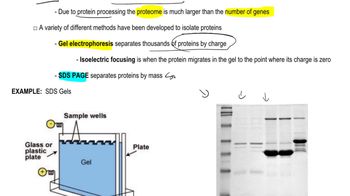
Gel Electrophoresis
Technique separating proteins based on physical properties like mass or charge using an electric field in a gel matrix.
SDS-PAGE
Form of gel electrophoresis that separates proteins primarily by mass using a detergent to denature them.
Isoelectric Focusing
Method separating proteins by their charge, allowing each to migrate to a position where its net charge is zero.
Well
Small indentation in a gel where protein samples are loaded before separation during electrophoresis.
Mass Spectrometry
Analytical technique identifying proteins by measuring mass and charge, often revealing amino acid sequences.
Tandem Mass Spectrometry
Advanced mass spectrometry method that fragments proteins to determine their amino acid sequence.
Protein Microarray
Platform using immobilized antibodies to detect and analyze proteins and their interactions in a sample.
Antibody
Protein molecule fixed to microarray plates, specifically binding to target proteins for detection.
Amino Acid Sequence
Order of amino acids in a protein, determining its structure and function, often identified by mass spectrometry.
Peak
Signal in mass spectrometry output representing a specific amino acid or protein fragment based on mass and charge.
 BackBack
 06:36
06:36