Skip to main content
Genetics
My Course
Learn
Exam Prep
AI Tutor
Study Guides
Textbook Solutions
Flashcards
Explore
Try the app
My Course
Learn
Exam Prep
AI Tutor
Study Guides
Textbook Solutions
Flashcards
Explore
Try the app
Back
Regulation of Transposable Elements quiz
You can tap to flip the card.
What role do non-coding RNAs play in the regulation of transposon movement?
You can tap to flip the card.
👆
What role do non-coding RNAs play in the regulation of transposon movement?
Non-coding RNAs such as siRNAs, microRNAs, and piRNAs help silence and stop transposon movement by targeting their transcripts for degradation.
Track progress
Control buttons has been changed to "navigation" mode.
1/15
Related flashcards
Related practice
Recommended videos
Regulation of Transposable Elements definitions
Regulation of Transposable Elements
15 Terms
Regulation of Transposable Elements
16. Transposable Elements
3 problems
Topic
Nicole
Transposable Elements in Eukaryotes
16. Transposable Elements
7 problems
Topic
Kylia
16. Transposable Elements
4 topics
8 problems
Chapter
Kylia
Guided course
06:38
Regulation
456
views
3
rank
1
comments
Terms in this set (15)
Hide definitions
What role do non-coding RNAs play in the regulation of transposon movement?
Non-coding RNAs such as siRNAs, microRNAs, and piRNAs help silence and stop transposon movement by targeting their transcripts for degradation.
In C. elegans, where does the TC1 transposon move and where does it remain stationary?
TC1 transposon moves in somatic cells but remains stationary in germ cells.
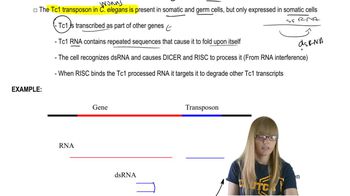
What happens to TC1 transposon RNA after it is transcribed in C. elegans germ cells?
The TC1 RNA folds into double-stranded RNA (dsRNA), which is then targeted for degradation.
Which proteins are involved in recognizing and degrading double-stranded RNA from transposons?
Dicer processes the dsRNA, and RISC binds to it, targeting the transposon transcripts for degradation.
Why do transposons in C. elegans germ cells not jump around like they do in somatic cells?
Their transcripts are immediately degraded by the Dicer and RISC pathway, preventing movement.
What is the function of the RISC protein complex in transposon regulation?
RISC binds to processed transposon RNA and targets it for degradation, suppressing transposon activity.
How do inverted repeats in transposon RNA contribute to its regulation?
Inverted repeats cause the RNA to fold into dsRNA, which is recognized and degraded by cellular machinery.
What are pi clusters and how do they relate to transposon regulation in animals?
Pi clusters are large regions of DNA containing transposons, whose transcripts are processed and used to degrade other transposon transcripts.
Which protein complexes with piRNA transcripts to regulate transposons?
The Argonaute protein complexes with processed piRNA transcripts to degrade transposon transcripts.
How does the CRISPR system regulate transposons in bacteria?
CRISPR targets transposon genes for silencing and degradation, preventing their movement.
What is the main pathway believed to silence transposons in cells where they are not expressed?
Non-coding RNAs are considered a major pathway for silencing transposons.
What is the significance of double-stranded RNA in the regulation of transposons?
Double-stranded RNA signals the cell to activate degradation pathways, preventing transposon movement.
What happens when TC1 transposon RNA is bound to RISC in C. elegans?
It targets and degrades other TC1 transcripts, preventing transposon jumping.
Are non-coding RNAs the only mechanism for transposon regulation?
No, scientists believe there may be other unknown regulatory mechanisms besides non-coding RNAs.
What is the role of Dicer in the regulation of transposon movement?
Dicer recognizes and processes double-stranded transposon RNA, initiating its degradation.
 BackBack

 06:38
06:38