What does the term RNAi stand for in the context of gene regulation?
RNAi stands for RNA interference, a mechanism that uses RNA molecules to prevent certain transcripts from being translated into proteins.
Which RNA molecule is first folded into a hairpin structure during the mechanism of RNA interference?
siRNA (short interfering RNA) is first folded into a hairpin structure before being processed in RNA interference.
Which processing steps are common to both miRNAs and siRNAs in RNA interference?
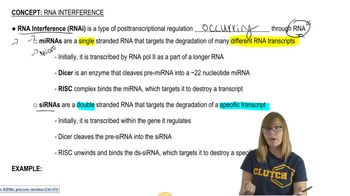
Both miRNAs and siRNAs are processed by the enzyme Dicer and interact with the RISC complex to bind and degrade target RNA transcripts.
Gene silencing through RNA interference is called __________.
Gene silencing through RNA interference is called post-transcriptional regulation.
Where are microRNAs (miRNAs) commonly found within genes?
MicroRNAs are often found in non-coding regions of genes, such as introns or regions upstream or downstream of the start codon.
What is the role of the enzyme Dicer in the processing of microRNAs?
Dicer cleaves the precursor microRNA (pre-miRNA) to produce a mature microRNA of about 22 nucleotides in length.
How does the RISC complex contribute to RNA interference after binding to miRNA or siRNA?
The RISC complex helps the miRNA or siRNA find complementary RNA transcripts and facilitates their degradation, preventing translation.
What structural change does RISC induce in siRNA during RNA interference?
RISC converts double-stranded siRNA into a single-stranded form by digesting one of the strands, creating a guide strand for targeting.
How do miRNAs and siRNAs identify their target RNA transcripts?
Both miRNAs and siRNAs use complementary base pairing to bind specifically to their target RNA transcripts.
What happens to an RNA transcript after it is bound by a miRNA or siRNA within the RISC complex?
The bound RNA transcript is marked for destruction and is not translated into a protein.
What is an RNA-resistant crop and how does RNA interference contribute to its development?
An RNA-resistant crop is a genetically modified plant that uses RNA interference mechanisms, such as siRNAs or miRNAs, to silence specific genes—often those of pests or pathogens—by degrading their RNA transcripts and preventing their translation into proteins. This post-transcriptional regulation helps protect the crop from diseases or pests by targeting and destroying harmful RNA sequences.
How do microRNAs (miRNAs) function in controlling gene expression through RNA interference?
MicroRNAs (miRNAs) control gene expression by being processed into short, single-stranded RNA segments (about 22 nucleotides) by the enzyme Dicer. These miRNAs then associate with the RISC complex, which guides them to bind complementary sequences on target RNA transcripts. This binding marks the transcripts for degradation, preventing their translation into proteins and thereby regulating gene expression post-transcriptionally.
 Back
Back
 06:59
06:59