What is true about the semiconservative replication of DNA?
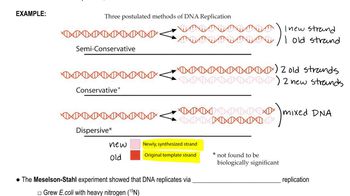
In semiconservative replication, each new DNA double helix consists of one original (parental) strand and one newly synthesized strand.
What does 'semi-conservative' mean in the context of DNA replication?
'Semi-conservative' means that after DNA replication, each new DNA molecule contains one strand from the original DNA and one newly synthesized strand.
What does semiconservative replication mean?
Semiconservative replication refers to the process by which DNA is copied so that each new double helix contains one old (parental) strand and one new strand.
Why is DNA replication called semi-conservative?
DNA replication is called semi-conservative because each new DNA molecule conserves one strand from the original molecule and synthesizes one new strand.
Which statement describes the semiconservative model of DNA replication correctly?
The semiconservative model states that each daughter DNA molecule consists of one parental strand and one newly synthesized strand.
Why is DNA replication called semi-conservative?
It is called semi-conservative because each new DNA double helix contains one strand from the original DNA and one newly made strand.
The term 'semiconservative' refers specifically to what aspect of DNA replication?
The term 'semiconservative' refers specifically to the fact that each new DNA molecule contains one original (parental) strand and one newly synthesized strand after replication.
What role did nitrogen isotopes play in the Meselson and Stahl experiment?
Nitrogen isotopes (N15 and N14) were used to distinguish old DNA strands from newly synthesized ones by their density, allowing scientists to track DNA replication patterns.
How did the results of the second round of replication in Meselson and Stahl's experiment help rule out the dispersive model?
After two rounds, the presence of both a mixed-weight band and a light-weight band showed that DNA was not continuously mixed, which contradicted the dispersive model's prediction of only mixed bands.
Why was E. coli chosen for the Meselson and Stahl experiment on DNA replication?
E. coli was chosen because it replicates and divides rapidly, making it ideal for observing multiple rounds of DNA replication in a short period.
Why is DNA replication called semiconservative?
DNA replication is called semiconservative because each new DNA molecule consists of one original (parental) strand and one newly synthesized strand.
What does semiconservative DNA replication mean?
Semiconservative DNA replication means that after replication, each DNA double helix contains one old (parental) strand and one new strand.
Explain why DNA replication is called semiconservative.
DNA replication is called semiconservative because the process produces two DNA molecules, each with one strand from the original molecule and one newly synthesized strand.
What is the product of DNA replication?
The product of DNA replication is two DNA double helices, each composed of one old strand and one new strand.
What does it mean that DNA replication is semiconservative?
It means that each new DNA molecule formed during replication contains one strand from the original DNA and one newly synthesized strand.
Why is DNA replication considered semiconservative?
DNA replication is considered semiconservative because each daughter DNA molecule retains one parental strand and incorporates one new strand.
What is meant by semiconservative replication of DNA?
Semiconservative replication of DNA refers to the process where each new DNA double helix contains one original strand and one new strand.
Which best describes the outcome of DNA replication?
The outcome of DNA replication is two DNA molecules, each with one parental strand and one newly synthesized strand.
What is the structural feature that allows DNA to replicate?
The double-stranded, complementary nature of DNA allows each strand to serve as a template for the synthesis of a new complementary strand.
How is DNA replication semiconservative?
DNA replication is semiconservative because each new DNA molecule contains one strand from the original DNA and one newly synthesized strand.
What does it mean for DNA to be semiconservative?
For DNA to be semiconservative means that after replication, each DNA molecule has one old strand and one new strand.
DNA replication results in two DNA molecules. What is the composition of these molecules?
Each resulting DNA molecule consists of one parental strand and one newly synthesized strand.
Why is DNA called semiconservative?
DNA is called semiconservative because, after replication, each new DNA molecule contains one original strand and one new strand.
What does semi-conservative mean in DNA replication?
Semi-conservative means that each new DNA double helix contains one strand from the original molecule and one newly synthesized strand.
What is semi-conservative DNA replication?
Semi-conservative DNA replication is the process by which each new DNA molecule contains one parental strand and one new strand.
What does it mean when DNA is semiconservative?
It means that each new DNA molecule formed during replication contains one original strand and one newly synthesized strand.
What is DNA replication called?
DNA replication is called semiconservative replication.
DNA is semiconservative. What does that mean?
It means that after replication, each DNA molecule contains one strand from the original DNA and one new strand.
How did Meselson and Stahl's experiment demonstrate semiconservative replication?
Meselson and Stahl grew E. coli in heavy nitrogen, then shifted them to light nitrogen, and observed that after replication, DNA molecules contained one heavy and one light strand, confirming semiconservative replication.
What evidence ruled out the conservative model of DNA replication?
The absence of separate heavy and light DNA bands after one round of replication in Meselson and Stahl's experiment ruled out the conservative model.
What evidence ruled out the dispersive model of DNA replication?
The appearance of both mixed and light DNA bands after two rounds of replication in Meselson and Stahl's experiment ruled out the dispersive model.
What is the role of nitrogen isotopes in Meselson and Stahl's experiment?
Nitrogen isotopes (N15 and N14) were used to distinguish old DNA strands from newly synthesized strands, allowing visualization of semiconservative replication.
What happens to the parental DNA strands during semiconservative replication?
During semiconservative replication, each parental DNA strand serves as a template for the synthesis of a new complementary strand.
After DNA is replicated, what is the composition of the new molecules?
Each new DNA molecule consists of one parental strand and one newly synthesized strand.
DNA replicates by which model?
DNA replicates by the semiconservative model.
When is the DNA in chromosomes replicated?
DNA in chromosomes is replicated before cell division, during the S phase of the cell cycle.
Why is the copying of information in DNA efficient?
Copying is efficient because each strand serves as a template, allowing accurate synthesis of complementary strands.
What does it mean when DNA replication is semiconservative?
It means that each new DNA molecule contains one original strand and one newly synthesized strand.
What is the outcome of one round of semiconservative DNA replication?
After one round, each DNA molecule consists of one parental strand and one new strand.
What is the outcome after two rounds of semiconservative DNA replication?
After two rounds, half the DNA molecules have one parental and one new strand, and half have two new strands.
 Back
Back
 14:31
14:31