Skip to main content
Genetics
My Course
Learn
Exam Prep
AI Tutor
Study Guides
Textbook Solutions
Flashcards
Explore
Try the app
My Course
Learn
Exam Prep
AI Tutor
Study Guides
Textbook Solutions
Flashcards
Explore
Try the app
Back
Studying the Genetics of Development definitions
You can tap to flip the card.
Model Organism
You can tap to flip the card.
👆
Model Organism
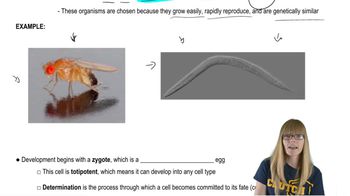
An easily studied species with genetic traits similar to humans, used to investigate developmental processes.
Track progress
Control buttons has been changed to "navigation" mode.
1/14
Related flashcards
Related practice
Recommended videos
Studying the Genetics of Development quiz
Studying the Genetics of Development
15 Terms
Studying the Genetics of Development
14. Genetic Control of Development
4 problems
Topic
Kylia
Developmental Patterning Genes
14. Genetic Control of Development
7 problems
Topic
Kylia
14. Genetic Control of Development
3 topics
8 problems
Chapter
Kylia
Guided course
08:30
Genetics of Development
899
views
5
rank
Terms in this set (14)
Hide definitions
Model Organism
An easily studied species with genetic traits similar to humans, used to investigate developmental processes.
Zygote
A fertilized egg cell possessing the potential to generate all cell types in an organism.
Totipotency
The capacity of a single cell to differentiate into any cell type within an organism.
Determination
The process by which a cell becomes committed to a specific fate, such as a particular cell type or function.
Mosaic Determination
A developmental mode where each cell's fate is fixed early, and loss of cells leads to abnormal development.
Regulative Determination
A developmental mode allowing cells to adjust fates based on environmental cues, compensating for cell loss.
Gene Regulation
The control of gene expression timing and location, crucial for proper development and cell specialization.
Mutation
A change in genetic material that can disrupt normal development, revealing gene function.
Variable Gene Activity Hypothesis
A concept proposing that selective gene activation or inactivation directs cell fate during development.
Cell Fate
The eventual identity or function a cell will acquire as development progresses.
Gene Expression
The process by which genetic information is used to produce functional products at specific times and locations.
C. elegans
A nematode model organism with a fully mapped cell lineage, ideal for studying developmental genetics.
Fruit Fly
A classic model organism in genetics, valued for its rapid life cycle and genetic tractability.
Cell Lineage
The developmental history of a cell as it divides and differentiates into specialized types.
 BackBack
 08:30
08:30