What are the tips of eukaryotic chromosomes called?
The tips of eukaryotic chromosomes are known as telomeres.
What is the primary function of telomeres?
The function of telomeres is to protect the ends of chromosomes from shortening during DNA replication, thereby preserving genetic information and preventing chromosome deterioration.
Why is the replication of the lagging strand at chromosome ends problematic?
The lagging strand requires primers for Okazaki fragments, but at the very end, there is no place for the last primer to bind, leading to incomplete replication and potential chromosome shortening.
What role does the RNA molecule within telomerase play during telomere extension?
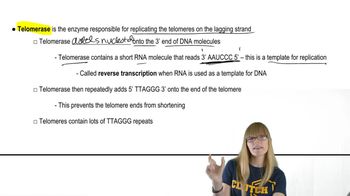
The RNA molecule acts as a template for telomerase to add complementary DNA repeats to the chromosome ends, enabling extension of the telomere.
What is the process called when telomerase uses its RNA template to synthesize DNA?
This process is called reverse transcription, where RNA serves as a template for DNA synthesis.
What repetitive DNA sequence is commonly found in human telomeres?
Human telomeres contain many repeats of the sequence TTAGGG.
Why is it acceptable for telomerase to add non-coding repetitive sequences to chromosome ends?
These repeats do not encode genetic information and serve only to protect chromosomes from shortening, so they do not harm the cell or organism.
How does telomerase activity differ between germ cells and somatic cells?
Germ cells have high telomerase activity to ensure complete chromosomes for offspring, while most somatic cells have little or no telomerase, leading to gradual telomere shortening.
What is cellular senescence and how is it related to telomeres?
Cellular senescence is a state where cells stop dividing due to critically short telomeres, remaining alive but inactive until eventual cell death.
How does telomere shortening in somatic cells contribute to aging?
As somatic cells replicate and their telomeres shorten, they eventually reach a point where they can no longer divide, contributing to cellular aging and tissue turnover.
What is the repetitive DNA found at the end of a eukaryotic chromosome called, and what is its function?
The repetitive DNA at the end of a eukaryotic chromosome is called a telomere. Telomeres consist of repeated nucleotide sequences (such as TTAGGG repeats) that protect chromosome ends from shortening during DNA replication, ensuring the integrity of genetic information.
What role does telomerase play in DNA replication?
Telomerase is an enzyme that extends the ends of chromosomes by adding repetitive nucleotide sequences to telomeres using an RNA template. This prevents telomere shortening during DNA replication, especially on the lagging strand, and is crucial for maintaining chromosome integrity in germ cells.
 Back
Back

 08:38
08:38