What is the function of the bla gene product in bacteria?
The bla gene encodes an enzyme that provides resistance to the antibiotic ampicillin by breaking it down, allowing bacteria carrying the gene to survive and grow in the presence of ampicillin.
What is the purpose of using agar in bacterial plating?
Agar provides a firm surface for bacteria to grow and form colonies without moving. It allows scientists to observe individual colonies derived from single cells.
How do prototrophic and auxotrophic bacteria differ in their growth requirements?
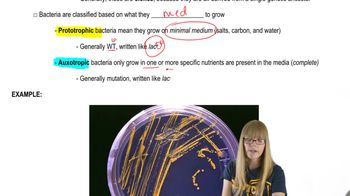
Prototrophic bacteria can grow on minimal media with basic nutrients, while auxotrophic bacteria require complete media with specific added nutrients. Auxotrophs are usually mutants lacking the ability to synthesize certain compounds.
Why are lab strains of E. coli preferred for genetic studies?
Lab strains of E. coli are non-pathogenic, fast-dividing, and easy to manipulate genetically. These traits make them ideal for controlled experiments in genetics research.
What is a bacterial colony and how does it form on a plate?
A bacterial colony is a visible clump of cells that arises from a single bacterium dividing repeatedly in one spot on the agar plate. All cells in a colony are genetic clones unless a mutation occurs.
What distinguishes plasmid DNA from chromosomal DNA in bacteria?
Plasmid DNA is small, circular, and contains non-essential but beneficial genes, while chromosomal DNA holds essential genes for bacterial survival. Plasmids exist independently of the main chromosome.
How can mutations in bacterial DNA be detected by scientists?
Mutations can be detected by observing changes in colony morphology, such as shape, size, or edge texture. Scientists also look for traits like antibiotic resistance or altered nutrient requirements.
What is horizontal gene transfer in bacteria and how does it differ from vertical transmission?
Horizontal gene transfer involves the movement of DNA between existing bacteria, not through offspring. Vertical transmission occurs during cell division, passing DNA to daughter cells.
Describe the process of bacterial transformation.
Transformation is when a bacterium takes up free DNA from its environment. This DNA can then be incorporated into the bacterial genome, potentially altering its traits.
What role do bacteriophages play in bacterial gene transfer?
Bacteriophages transfer DNA to bacteria through a process called transduction. This allows genetic material from one bacterium to be introduced into another via viral infection.
 Back
Back
 09:35
09:35