 Back
BackGene Regulation in Bacteria - Genetics
 04:27
04:27
Terms in this set (20)
Constitutive transcription is continuous transcription of a gene regardless of environmental conditions.
Regulated transcription is transcription turned on or off in response to changing environmental conditions.
1. Transcriptional regulation (e.g., inducible and repressible transcription)
2. Posttranscriptional regulation (e.g., mRNA destruction, translation blockage)
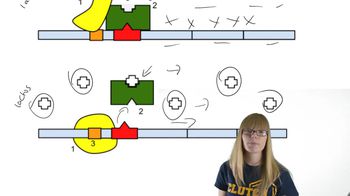
Repressor proteins bind to operator sequences to block RNA polymerase and inhibit transcription (negative regulation).
Activator proteins increase RNA polymerase binding to the promoter, enhancing transcription (positive regulation).
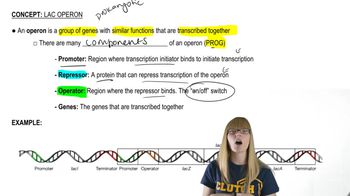
An operon is a single transcriptional unit containing multiple structural genes controlled by one promoter and operator.
lacZ: β-galactosidase; lacY: permease; lacA: transacetylase.
lacI encodes the lac repressor protein, which binds the operator to inhibit transcription; it is constitutively expressed.
Allolactose binds the lac repressor, causing it to release from the operator and allowing transcription.
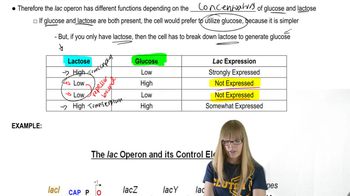
Catabolite repression is positive regulation where CAP-cAMP complex enhances lac operon transcription when glucose is low.
High glucose leads to low cAMP; low glucose leads to high cAMP, which binds CAP to activate transcription.
CAP-cAMP binds near the lac promoter and interacts with RNA polymerase to increase transcription efficiency.
Inducible transcription is turned on by an inducer (e.g., lac operon). Repressible transcription is turned off by a corepressor (e.g., trp operon).
When tryptophan is present, it acts as a corepressor activating the repressor to block transcription of the trp operon.
Attenuation is a regulatory mechanism that controls transcription termination based on metabolite levels (e.g., trp operon).
A common DNA-binding domain in regulatory proteins that allows specific binding to operator sequences.
Symmetry allows dimeric regulatory proteins to bind DNA more effectively by recognizing inverted repeats.
Alternative sigma factors direct RNA polymerase to specific promoters to activate large groups of genes under certain conditions.
In bacteria, translation of mRNA begins while transcription is still in progress, allowing rapid gene expression.
The operator is a DNA sequence where repressor proteins bind to regulate transcription.