Information storage, replication, expression, and variation by mutation are the four key criteria a molecule must fulfill to serve as genetic material.
Central dogma of molecular genetics
Information flows from DNA to RNA to protein through transcription and translation.
Tetranucleotide hypothesis
Early 20th-century idea that DNA was composed of repeating units of four nucleotides in equal amounts, leading to the belief DNA was too simple to be genetic material.
Griffith's transformation experiment
Showed that a "transforming principle" from dead virulent bacteria could convert live avirulent bacteria into virulent form.
Avery, MacLeod, and McCarty experiment
Identified DNA as the transforming principle by showing only DNA could transform avirulent bacteria into virulent forms after enzymatic digestion.
Hershey-Chase experiment
Used bacteriophages labeled with radioactive isotopes to prove DNA, not protein, is the genetic material entering bacteria during infection.
Nucleotide components
Each nucleotide consists of a pentose sugar (deoxyribose in DNA), a nitrogenous base (purines or pyrimidines), and a phosphate group.
Phosphodiester bond
Covalent bond linking the 5' phosphate of one nucleotide to the 3' hydroxyl of the next, forming the sugar-phosphate backbone.
Watson and Crick DNA model
DNA is a double helix with two antiparallel strands; adenine pairs with thymine via two hydrogen bonds, guanine pairs with cytosine via three.
Chargaff's rules
In DNA, the amount of adenine equals thymine, and guanine equals cytosine; the (A+T)/(G+C) ratio varies among species.
Role of Rosalind Franklin's X-ray diffraction
Provided critical evidence of DNA's helical structure and periodicity, supporting the double helix model.
Differences between DNA and RNA sugars
DNA contains deoxyribose, while RNA contains ribose.
Differences in nitrogenous bases between DNA and RNA
DNA uses thymine; RNA uses uracil instead of thymine.
Strandedness of DNA vs RNA
DNA is usually double-stranded; RNA is usually single-stranded.
Main classes of RNA and their functions
mRNA carries genetic info, rRNA forms ribosome structure, tRNA brings amino acids during protein synthesis.
RNA as genetic material in viruses
Some viruses, like retroviruses, use RNA as genetic material and replicate via reverse transcription to DNA.
DNA denaturation and melting temperature (Tm)
Denaturation separates DNA strands; Tm is the temperature where half the DNA is denatured.
Molecular hybridization
Process where complementary single strands from different sources anneal; basis for techniques like FISH.
Electrophoresis in nucleic acid analysis
Technique that separates DNA or RNA fragments by size using an electric field.
RNA world hypothesis
Proposes RNA was the original genetic material due to its ability to store information and catalyze reactions.
 Back
Back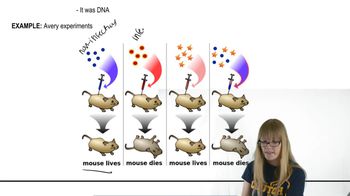
 09:32
09:32