Skip to main content
Genetics
My Course
Learn
Exam Prep
AI Tutor
Study Guides
Textbook Solutions
Flashcards
Explore
Try the app
My Course
Learn
Exam Prep
AI Tutor
Study Guides
Textbook Solutions
Flashcards
Explore
Try the app
Back
Genetics: Gene Regulation and the lac Operon
You can tap to flip the card.
What is the role of allosteric effectors in gene regulation?
You can tap to flip the card.
👆
What is the role of allosteric effectors in gene regulation?
Allosteric effectors bind regulatory proteins, causing conformational changes that affect DNA binding and regulate transcription.
Track progress
Control buttons has been changed to "navigation" mode.
1/20
Recommended videos
Guided course
04:27
Lac Operon Overview
3222
views
66
rank
2
comments
Guided course
06:55
Lac Operon Regulation
2700
views
35
rank
2
comments
Guided course
07:01
Lac Operon Summary
2191
views
26
rank
3
comments
Terms in this set (20)
Hide definitions
What is the role of allosteric effectors in gene regulation?
Allosteric effectors bind regulatory proteins, causing conformational changes that affect DNA binding and regulate transcription.
How does an inducer affect a repressor protein?
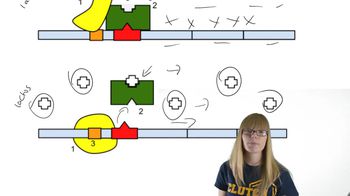
An inducer binds the repressor's allosteric domain, preventing it from binding DNA and allowing transcription.
What happens when a corepressor binds a repressor protein?
The corepressor-repressor complex binds DNA, blocking transcription by negative regulation.
What is coupled transcription and translation in bacteria?
In bacteria, translation begins on mRNA while it is still being transcribed by RNA polymerase.
What are the three structural genes of the lac operon and their functions?
lacZ encodes β-galactosidase, lacY encodes permease, and lacA encodes transacetylase.
What is the function of the lacI gene?
lacI encodes the lac repressor protein, which binds the operator to inhibit transcription; it is constitutively expressed.
How does the lac repressor regulate the lac operon?
The lac repressor binds the operator sequence to block transcription; binding of allolactose inducer causes it to release DNA.
What is catabolite repression in the lac operon?
Catabolite repression is positive regulation where CAP-cAMP complex enhances RNA polymerase binding to the lac promoter when glucose is low.
How do glucose and lactose levels affect lac operon expression?
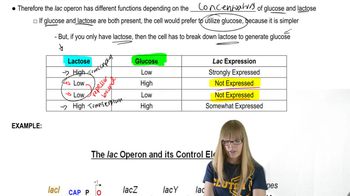
High glucose lowers cAMP, reducing CAP binding; lactose presence inactivates the repressor, allowing transcription if CAP is bound.
What happens to lac operon transcription when glucose is high and lactose is low?
cAMP is low, CAP is unbound, and lac repressor binds operator, so transcription is off.
What happens to lac operon transcription when glucose is low and lactose is high?
cAMP is high, CAP binds promoter, lac repressor is inactivated by allolactose, so transcription is on.
What is the role of the CAP-cAMP complex in lac operon regulation?
CAP-cAMP binds the promoter region, increasing RNA polymerase affinity and activating transcription.
What is the structure of the lac operon promoter region?
It includes the CAP binding site, -35 and -10 sequences, operator, and Shine-Dalgarno sequence for translation initiation.
What is the significance of symmetrical DNA binding sites in gene regulation?
Symmetrical binding sites allow dimeric regulatory proteins to bind DNA with high specificity and stability.
How does the lac repressor protein bind DNA?
It uses helix-turn-helix motifs to bind operator DNA sequences and block transcription.
What is the metabolic role of β-galactosidase in lactose metabolism?
β-galactosidase cleaves lactose into glucose and galactose for bacterial metabolism.
What is the function of permease in the lac operon?
Permease facilitates lactose transport into the bacterial cell.
What is the role of allolactose in lac operon regulation?
Allolactose acts as an inducer by binding the lac repressor and preventing it from binding the operator.
How does the tryptophan operon differ from the lac operon in regulation?
The tryptophan operon is repressible and uses a corepressor (tryptophan) to activate the repressor and block transcription.
What triggers transcription in the tryptophan operon?
Transcription occurs when tryptophan is absent, inactivating the repressor and allowing gene expression.
 BackBack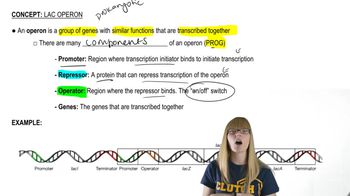
 04:27
04:27