Pearson+ LogoPearson+ Logo
Ch. 11 - Chromosome Structure and DNA Sequence Organization
Klug - Essentials of Genetics 10th Edition
Klug10th EditionEssentials of GeneticsISBN: 9780135588789Not the one you use?Change textbook
Chapter 11, Problem 18

The human genome contains approximately 106 copies of an Alu sequence, one of the best-studied classes of short interspersed elements (SINEs), per haploid genome. Individual Alu units share a 282-nucleotide consensus sequence followed by a 3'-adenine-rich tail region [Schmid (1998)]. Given that there are approximately 3 x 10⁹ base pairs per human haploid genome, about how many base pairs are spaced between each Alu sequence?

Verified step by step guidance
1
Identify the total number of base pairs in the human haploid genome, which is given as approximately \$3 \times 10^{9}$ base pairs.
Note the total number of Alu sequences per haploid genome, which is approximately \$10^{6}$ copies.
Understand that the problem asks for the average spacing between each Alu sequence, meaning the average number of base pairs between consecutive Alu elements.
Calculate the average spacing by dividing the total number of base pairs by the total number of Alu sequences using the formula: \(\text{Average spacing} = \frac{\text{Total base pairs}}{\text{Number of Alu sequences}}\)
Substitute the given values into the formula: \(\text{Average spacing} = \frac{3 \times 10^{9}}{10^{6}}\) This will give the average number of base pairs between each Alu sequence.

Verified video answer for a similar problem:

This video solution was recommended by our tutors as helpful for the problem above.
Video duration:
2m
Was this helpful?

Key Concepts

Here are the essential concepts you must grasp in order to answer the question correctly.

Human Genome Size and Structure

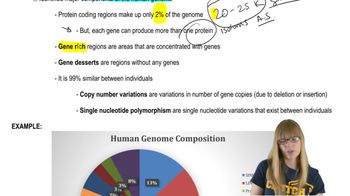
The human haploid genome contains about 3 billion base pairs (3 x 10^9 bp). This total DNA length is organized into chromosomes and includes coding and non-coding regions. Understanding genome size is essential for calculating average distances between repeated sequences like Alu elements.
Recommended video:
Guided course
06:51
Human Genome Composition

Alu Sequences and Short Interspersed Elements (SINEs)

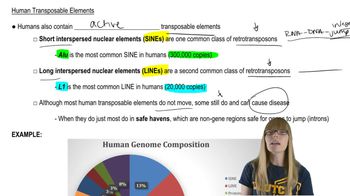
Alu sequences are a type of SINE, approximately 282 base pairs long, repeated about one million times per haploid genome. These repetitive elements are dispersed throughout the genome and can be used as markers for genetic studies. Their abundance affects genome structure and spacing calculations.
Recommended video:
Guided course
05:30
Human Transposable Elements

Calculating Average Spacing Between Repetitive Elements

To find the average spacing between repetitive sequences, divide the total genome size by the number of repeats. This gives the average number of base pairs between each element, assuming even distribution. This concept helps estimate genomic distances between Alu sequences.
Recommended video: