
Contrast the various categories of repetitive DNA.
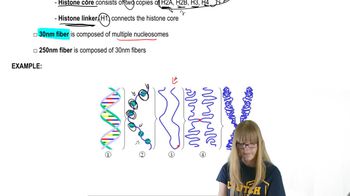
Mammals contain a diploid genome consisting of at least 10⁹ bp. If this amount of DNA is present as chromatin fibers, where each group of 200 bp of DNA is combined with 9 histones into a nucleosome and each group of 6 nucleosomes is combined into a solenoid, achieving a final packing ratio of 50, determine:
(a) the total number of nucleosomes in all fibers,
(b) the total number of histone molecules combined with DNA in the diploid genome, and
(c) the combined length of all fibers.
Verified step by step guidance
Verified video answer for a similar problem:
Key Concepts
Nucleosome Structure and Composition
Chromatin Fiber Organization and Solenoid Model
DNA Packing Ratio and Genome Size
Define satellite DNA. Describe where it is found in the genome of eukaryotes and its role as part of chromosomes.
Contrast the structure of SINE and LINE DNA sequences. Why are LINEs referred to as retrotransposons?
Assume that a viral DNA molecule is a 50-µm-long circular strand with a uniform 20-Å diameter. If this molecule is contained in a viral head that is a 0.08-µm-diameter sphere, will the DNA molecule fit into the viral head, assuming complete flexibility of the molecule? Justify your answer mathematically.
How many base pairs are in a molecule of phage T2 DNA 52-µm long?
The human genome contains approximately 106 copies of an Alu sequence, one of the best-studied classes of short interspersed elements (SINEs), per haploid genome. Individual Alu units share a 282-nucleotide consensus sequence followed by a 3'-adenine-rich tail region [Schmid (1998)]. Given that there are approximately 3 x 10⁹ base pairs per human haploid genome, about how many base pairs are spaced between each Alu sequence?
