Ch. 16 - Regulation of Gene Expression in Eukaryotes

Klug10th EditionEssentials of GeneticsISBN: 9780135588789
Not the one you use?Change textbookSelect a different textbook
Table of contents
- Ch. 1 - Introduction to Genetics16
- Ch. 2 - Mitosis and Meiosis28
- Ch. 3 - Mendelian Genetics37
- Ch. 4 - Modification of Mendelian Ratios53
- Ch. 5 - Sex Determination and Sex Chromosomes32
- Ch. 6 - Chromosome Mutations: Variation in Number and Arrangement37
- Ch. 7 - Linkage and Chromosome Mapping in Eukaryotes36
- Ch. 8 - Genetic Analysis and Mapping in Bacteria and Bacteriophages24
- Ch. 9 - DNA Structure and Analysis38
- Ch. 10 - DNA Replication29
- Ch. 11 - Chromosome Structure and DNA Sequence Organization22
- Ch. 12 - The Genetic Code and Transcription36
- Ch. 13 - Translation and Proteins27
- Ch. 14 - Gene Mutation, DNA Repair, and Transposition34
- Ch. 15 - Regulation of Gene Expression in Bacteria22
- Ch. 16 - Regulation of Gene Expression in Eukaryotes37
- Ch. 17 - Recombinant DNA Technology27
- Ch. 18 - Genomics, Bioinformatics, and Proteomics30
- Ch. 19 - The Genetics of Cancer21
- Ch. 20 - Quantitative Genetics and Multifactorial Traits37
- Ch. 21 - Population and Evolutionary Genetics45

Chapter 16, Problem 21
In principle, RNAi may be used to fight viral infection. How might this work?
 Verified step by step guidance
1
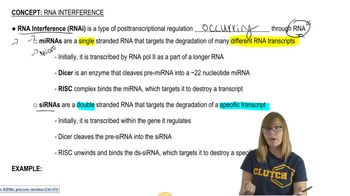
Understand that RNA interference (RNAi) is a natural cellular process where small RNA molecules inhibit gene expression by targeting specific messenger RNA (mRNA) molecules for degradation or translational repression.
Recognize that viruses rely on their RNA or DNA to produce viral proteins by transcribing viral genes into mRNA, which is then translated by the host cell machinery.
Consider that RNAi can be designed to target viral mRNA sequences specifically, leading to the degradation of these viral mRNAs and preventing the production of viral proteins necessary for viral replication.
Note that by introducing small interfering RNAs (siRNAs) or short hairpin RNAs (shRNAs) complementary to viral mRNA, the RNA-induced silencing complex (RISC) can be guided to these viral transcripts to silence them effectively.
Conclude that this targeted silencing reduces viral replication and spread within the host, thereby helping to fight the viral infection.
Key Concepts
Here are the essential concepts you must grasp in order to answer the question correctly.
RNA Interference (RNAi) Mechanism
RNA interference is a biological process where small RNA molecules, such as siRNA or miRNA, guide the degradation or translational repression of specific messenger RNA (mRNA) molecules, effectively silencing gene expression. This mechanism can target viral RNA to prevent the production of viral proteins.
Recommended video:
Guided course
 06:59
06:59
RNA Interference
Viral Replication and RNA Targeting
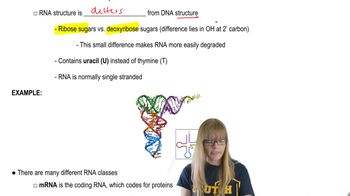
Viruses rely on their RNA or DNA to replicate inside host cells. RNAi can be designed to specifically recognize and degrade viral RNA sequences, thereby blocking the virus's ability to replicate and spread within the host organism.
Recommended video:
Therapeutic Application of RNAi
Using RNAi as a therapy involves delivering synthetic or vector-expressed small RNAs into infected cells to trigger the RNAi pathway against viral genes. This approach offers a targeted antiviral strategy with potential for high specificity and reduced side effects compared to traditional drugs.
Recommended video:
Guided course
 04:15
04:15Artificial Selection
Related Practice