Ch. 16 - Regulation of Gene Expression in Eukaryotes

Klug10th EditionEssentials of GeneticsISBN: 9780135588789
Not the one you use?Change textbookSelect a different textbook
Table of contents
- Ch. 1 - Introduction to Genetics16
- Ch. 2 - Mitosis and Meiosis28
- Ch. 3 - Mendelian Genetics37
- Ch. 4 - Modification of Mendelian Ratios53
- Ch. 5 - Sex Determination and Sex Chromosomes32
- Ch. 6 - Chromosome Mutations: Variation in Number and Arrangement37
- Ch. 7 - Linkage and Chromosome Mapping in Eukaryotes36
- Ch. 8 - Genetic Analysis and Mapping in Bacteria and Bacteriophages24
- Ch. 9 - DNA Structure and Analysis38
- Ch. 10 - DNA Replication29
- Ch. 11 - Chromosome Structure and DNA Sequence Organization22
- Ch. 12 - The Genetic Code and Transcription36
- Ch. 13 - Translation and Proteins27
- Ch. 14 - Gene Mutation, DNA Repair, and Transposition34
- Ch. 15 - Regulation of Gene Expression in Bacteria22
- Ch. 16 - Regulation of Gene Expression in Eukaryotes37
- Ch. 17 - Recombinant DNA Technology27
- Ch. 18 - Genomics, Bioinformatics, and Proteomics30
- Ch. 19 - The Genetics of Cancer21
- Ch. 20 - Quantitative Genetics and Multifactorial Traits37
- Ch. 21 - Population and Evolutionary Genetics45

Chapter 16, Problem 1a
In this chapter, we focused on the regulation of gene expression in eukaryotes. At the same time, we found many opportunities to consider the methods and reasoning by which much of this information was acquired. From the explanations given in the chapter:
How do we know that transcription and translation are spatially and temporally separated in eukaryotic cells?
 Verified step by step guidance
1
For part (a), consider experiments using cell fractionation and microscopy that show mRNA synthesis occurs in the nucleus while protein synthesis occurs in the cytoplasm, demonstrating spatial separation. Additionally, time-course studies tracking newly synthesized RNA and proteins reveal temporal separation between transcription and translation in eukaryotic cells.
For part (b), examine studies where DNA methylation patterns are mapped alongside gene expression data. Techniques like bisulfite sequencing reveal methylated cytosines, and correlating these with low or absent transcription levels indicates that DNA methylation is associated with transcriptional silencing.
For part (c), look at mutational analyses and reporter gene assays where core-promoter elements (such as the TATA box) are altered or deleted. Observing reduced or abolished transcription in these experiments shows the importance of core-promoter elements in initiating transcription.
For part (d), review experiments involving promoter and enhancer constructs linked to reporter genes. Changing the orientation of promoters relative to the transcription start site typically disrupts transcription, while enhancers maintain their function regardless of orientation, demonstrating orientation dependence for promoters and independence for enhancers.
For part (e), analyze RNA sequencing and protein isoform studies that identify multiple mRNA variants produced from a single gene due to alternative splicing. Functional assays comparing these isoforms show that they can have different biological activities, confirming that alternative splicing generates functionally diverse proteins.
For part (f), consider experiments using small RNA knockdown or overexpression, along with reporter assays, that demonstrate how small noncoding RNAs (like miRNAs and siRNAs) can decrease target mRNA levels or inhibit translation, thereby regulating gene expression post-transcriptionally.
Key Concepts
Here are the essential concepts you must grasp in order to answer the question correctly.
Spatial and Temporal Separation of Transcription and Translation in Eukaryotes
In eukaryotic cells, transcription occurs in the nucleus where DNA is transcribed into RNA, while translation happens in the cytoplasm where ribosomes synthesize proteins. This separation is demonstrated by experiments using cell fractionation and microscopy, showing mRNA processing steps like splicing occur before export. This spatial and temporal separation allows for complex regulation of gene expression.
Recommended video:
Guided course
 09:16
09:16
Eukaryotic Transcription
DNA Methylation and Transcriptional Silencing
DNA methylation involves adding methyl groups to cytosine bases, often in CpG islands, leading to gene silencing. Experimental evidence includes correlation of methylation patterns with inactive genes and use of demethylating agents that reactivate transcription. Methylation can prevent transcription factor binding or recruit proteins that compact chromatin, thus repressing gene expression.
Recommended video:
Guided course
09:16Eukaryotic Transcription
Role of Core-Promoter Elements and Enhancer Orientation in Transcription
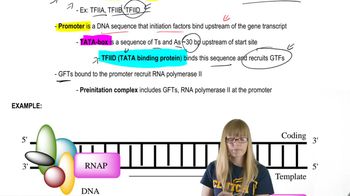
Core-promoter elements like the TATA box are essential DNA sequences near the transcription start site that recruit RNA polymerase II and initiate transcription. Their orientation is critical for proper function. In contrast, enhancers are regulatory DNA elements that can function regardless of orientation or distance, enhancing transcription by interacting with promoters through DNA looping, as shown by reporter assays and mutational analyses.
Recommended video:
Guided course
09:16Eukaryotic Transcription
Related Practice