Ch. 16 - Regulation of Gene Expression in Eukaryotes

Klug10th EditionEssentials of GeneticsISBN: 9780135588789
Not the one you use?Change textbookSelect a different textbook
Table of contents
- Ch. 1 - Introduction to Genetics16
- Ch. 2 - Mitosis and Meiosis28
- Ch. 3 - Mendelian Genetics37
- Ch. 4 - Modification of Mendelian Ratios53
- Ch. 5 - Sex Determination and Sex Chromosomes32
- Ch. 6 - Chromosome Mutations: Variation in Number and Arrangement37
- Ch. 7 - Linkage and Chromosome Mapping in Eukaryotes36
- Ch. 8 - Genetic Analysis and Mapping in Bacteria and Bacteriophages24
- Ch. 9 - DNA Structure and Analysis38
- Ch. 10 - DNA Replication29
- Ch. 11 - Chromosome Structure and DNA Sequence Organization22
- Ch. 12 - The Genetic Code and Transcription36
- Ch. 13 - Translation and Proteins27
- Ch. 14 - Gene Mutation, DNA Repair, and Transposition34
- Ch. 15 - Regulation of Gene Expression in Bacteria22
- Ch. 16 - Regulation of Gene Expression in Eukaryotes37
- Ch. 17 - Recombinant DNA Technology27
- Ch. 18 - Genomics, Bioinformatics, and Proteomics30
- Ch. 19 - The Genetics of Cancer21
- Ch. 20 - Quantitative Genetics and Multifactorial Traits37
- Ch. 21 - Population and Evolutionary Genetics45

Chapter 16, Problem 1c
In this chapter, we focused on the regulation of gene expression in eukaryotes. At the same time, we found many opportunities to consider the methods and reasoning by which much of this information was acquired. From the explanations given in the chapter:
How do we know that core-promoter elements are important for transcription?
 Verified step by step guidance
1
Understand that core-promoter elements are specific DNA sequences located near the transcription start site that help initiate transcription by serving as binding sites for transcription factors and RNA polymerase II.
Review experimental approaches such as mutational analysis, where specific changes or deletions are made to the core-promoter sequences to observe the effect on transcription levels.
Consider reporter gene assays, where the core-promoter region is linked to a reporter gene (like luciferase or GFP) and the activity of the reporter is measured to assess the promoter's functionality.
Examine DNA footprinting or electrophoretic mobility shift assays (EMSAs) that demonstrate the binding of transcription factors to core-promoter elements, indicating their role in transcription initiation.
Integrate the evidence from these experiments to conclude that disruption or alteration of core-promoter elements leads to decreased or abolished transcription, confirming their importance.
Key Concepts
Here are the essential concepts you must grasp in order to answer the question correctly.
Core-Promoter Elements
Core-promoter elements are specific DNA sequences located near the transcription start site that serve as binding sites for the transcription machinery. They are essential for initiating transcription by RNA polymerase II and include motifs like the TATA box and Initiator (Inr). Their presence and integrity directly influence the efficiency and accuracy of gene transcription.
Recommended video:
Guided course
 05:30
05:30
Human Transposable Elements
Experimental Evidence for Promoter Function
The importance of core-promoter elements is demonstrated through experiments such as mutational analysis, reporter gene assays, and DNA footprinting. By altering or deleting these sequences, researchers observe changes in transcription levels, confirming their role. These methods help establish a causal relationship between promoter elements and transcriptional activity.
Recommended video:
Guided course
 08:26
08:26Functional Genomics
Transcription Initiation Complex Assembly
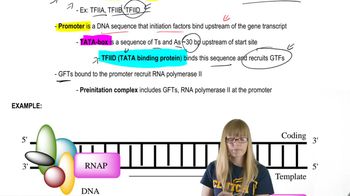
Core-promoter elements facilitate the assembly of the transcription initiation complex, including general transcription factors and RNA polymerase II. This complex formation is crucial for starting transcription. Understanding how these elements recruit and position the machinery explains why they are vital for gene expression regulation.
Recommended video:
Guided course
 09:16
09:16Eukaryotic Transcription
Related Practice