Ch. 16 - Regulation of Gene Expression in Eukaryotes

Klug10th EditionEssentials of GeneticsISBN: 9780135588789
Not the one you use?Change textbookSelect a different textbook
Table of contents
- Ch. 1 - Introduction to Genetics16
- Ch. 2 - Mitosis and Meiosis28
- Ch. 3 - Mendelian Genetics37
- Ch. 4 - Modification of Mendelian Ratios53
- Ch. 5 - Sex Determination and Sex Chromosomes32
- Ch. 6 - Chromosome Mutations: Variation in Number and Arrangement37
- Ch. 7 - Linkage and Chromosome Mapping in Eukaryotes36
- Ch. 8 - Genetic Analysis and Mapping in Bacteria and Bacteriophages24
- Ch. 9 - DNA Structure and Analysis38
- Ch. 10 - DNA Replication29
- Ch. 11 - Chromosome Structure and DNA Sequence Organization22
- Ch. 12 - The Genetic Code and Transcription36
- Ch. 13 - Translation and Proteins27
- Ch. 14 - Gene Mutation, DNA Repair, and Transposition34
- Ch. 15 - Regulation of Gene Expression in Bacteria22
- Ch. 16 - Regulation of Gene Expression in Eukaryotes37
- Ch. 17 - Recombinant DNA Technology27
- Ch. 18 - Genomics, Bioinformatics, and Proteomics30
- Ch. 19 - The Genetics of Cancer21
- Ch. 20 - Quantitative Genetics and Multifactorial Traits37
- Ch. 21 - Population and Evolutionary Genetics45

Chapter 16, Problem 29a
Many viruses that infect eukaryotic cells express genes that alter the regulation of host gene expression to promote viral replication. For example, herpes simplex virus-1 (HSV-1) expresses a protein called ICP0, which is necessary for successful viral infection and replication within the host. Lutz et al. (2017. Viruses 9: 210) showed that ICP0 can act as a ubiquitin ligase and target the redundant transcriptional repressors ZEB1 and ZEB2, which leads to upregulation of the miR-183 cluster (a set of three miRNAs transcribed from the same locus).
What likely happens to ZEB1 and ZEB2 upon HSV-1 infection?
 Verified step by step guidance
1
Understand the role of ICP0 protein expressed by HSV-1: ICP0 functions as a ubiquitin ligase, which means it can attach ubiquitin molecules to specific target proteins.
Recall that ubiquitination often tags proteins for degradation by the proteasome, a cellular complex responsible for breaking down unwanted or damaged proteins.
Identify the targets of ICP0's ubiquitin ligase activity: ZEB1 and ZEB2 are transcriptional repressors that are redundant, meaning they have overlapping functions.
Consider the effect of ubiquitination on ZEB1 and ZEB2: ICP0-mediated ubiquitination likely leads to their degradation, reducing their levels in the host cell.
Conclude that the degradation of ZEB1 and ZEB2 removes repression on the miR-183 cluster, resulting in its upregulation during HSV-1 infection.
Key Concepts
Here are the essential concepts you must grasp in order to answer the question correctly.
Ubiquitin-Mediated Protein Degradation
Ubiquitin ligases tag specific proteins with ubiquitin molecules, marking them for degradation by the proteasome. This process regulates protein levels and activity within the cell. In the context of viral infection, viral proteins like ICP0 can hijack this system to degrade host proteins that restrict viral replication.
Recommended video:
Guided course
 05:05
05:05
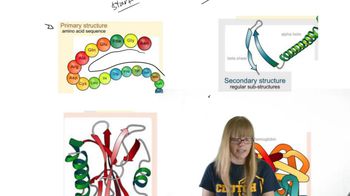
Proteins
Transcriptional Repressors ZEB1 and ZEB2
ZEB1 and ZEB2 are transcription factors that repress gene expression by binding to DNA and inhibiting transcription. They regulate various cellular processes, including development and differentiation. Their degradation can relieve repression, leading to increased expression of target genes such as the miR-183 cluster.
Recommended video:
Guided course
 09:16
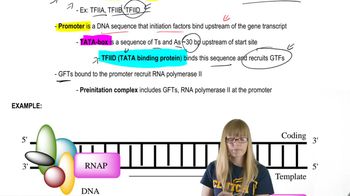
09:16Eukaryotic Transcription
MicroRNA (miRNA) Clusters and Gene Regulation
miRNAs are small non-coding RNAs that regulate gene expression post-transcriptionally by targeting mRNAs for degradation or translational repression. miRNA clusters are groups of miRNAs transcribed together from a single locus, allowing coordinated regulation of multiple genes. Upregulation of the miR-183 cluster can influence host cell pathways to favor viral replication.
Recommended video:
Guided course
 06:38
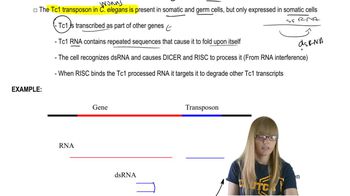
06:38Regulation
Related Practice