
Pearson+ LogoPearson+ Logo
Ch. 17 - Recombinant DNA Technology
Klug - Essentials of Genetics 10th Edition
Klug10th EditionEssentials of GeneticsISBN: 9780135588789Not the one you use?Change textbook
Chapter 17, Problem 21

Gene targeting and gene editing are both techniques for removing or modifying a particular gene, each of which can produce the same ultimate goal. What is the main technical difference in how DNA is modified that differs between these approaches?

Verified step by step guidance
1
Understand that both gene targeting and gene editing aim to modify specific DNA sequences within the genome, but they use different molecular mechanisms to achieve this.
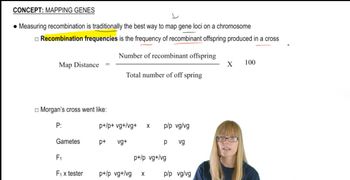
Gene targeting typically relies on homologous recombination, a natural cellular process where a piece of introduced DNA with sequences homologous to the target site replaces or modifies the endogenous gene through crossover events.
Gene editing, on the other hand, often uses engineered nucleases (such as CRISPR-Cas9, TALENs, or ZFNs) to create targeted double-strand breaks (DSBs) at specific genomic locations.
After the DSB is introduced in gene editing, the cell's repair machinery fixes the break either by non-homologous end joining (NHEJ), which can introduce insertions or deletions, or by homology-directed repair (HDR) if a repair template is provided, allowing precise modifications.
Therefore, the main technical difference lies in gene targeting using homologous recombination without necessarily inducing breaks, while gene editing actively induces targeted DNA breaks to stimulate repair pathways for modification.

Verified video answer for a similar problem:

This video solution was recommended by our tutors as helpful for the problem above.
Video duration:
2m
Was this helpful?

Key Concepts

Here are the essential concepts you must grasp in order to answer the question correctly.

Gene Targeting

Gene targeting is a technique that uses homologous recombination to introduce specific changes into a gene by replacing or disrupting it with a designed DNA sequence. This method relies on the cell's natural DNA repair mechanisms to incorporate the introduced DNA at a precise location.
Recommended video:
Guided course
09:09
Mapping Genes

Gene Editing

Gene editing involves directly cutting the DNA at a specific site using engineered nucleases like CRISPR-Cas9, TALENs, or ZFNs, followed by the cell's repair processes to introduce mutations or insertions. It allows precise and efficient modification without necessarily relying on homologous recombination.
Recommended video:
Guided course
09:09
Mapping Genes

DNA Repair Mechanisms

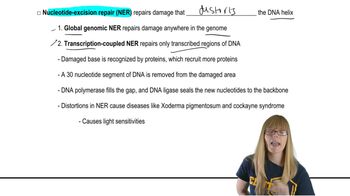
Cells repair DNA breaks primarily through homologous recombination (HR) or non-homologous end joining (NHEJ). Gene targeting depends on HR for precise DNA replacement, while gene editing often exploits NHEJ or HR after nuclease-induced double-strand breaks to achieve desired modifications.
Recommended video:
Guided course
05:44
Repair Pathways