
Textbook Question
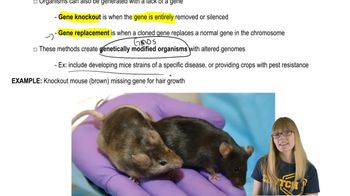
When disrupting a mouse gene by knockout, why is it desirable to breed mice until offspring homozygous (−/−) for the knockout target gene are obtained?
477
views

 Verified step by step guidance
 09:12
09:12
 09:09
09:09 02:48
02:48When disrupting a mouse gene by knockout, why is it desirable to breed mice until offspring homozygous (−/−) for the knockout target gene are obtained?
The CRISPR-Cas system has great potential but also raises many ethical issues about its potential applications because, theoretically, it can be used to edit any gene in the genome. What do you think are some of the concerns about the use of CRISPR-Cas on humans? Should CRISPR-Cas applications be limited for use on only certain human genes but not others? Explain your answers.
Gene targeting and gene editing are both techniques for removing or modifying a particular gene, each of which can produce the same ultimate goal. What is the main technical difference in how DNA is modified that differs between these approaches?
What is the difference between a knockout animal and a transgenic animal?
How is fluorescent in situ hybridization (FISH) used to produce a spectral karyotype?
Traditional Sanger sequencing has largely been replaced in recent years by next-generation and third-generation sequencing approaches. Describe advantages of these sequencing methods over first-generation Sanger sequencing.