Pearson+ LogoPearson+ Logo
Ch. 18 - Genomics, Bioinformatics, and Proteomics
Klug - Essentials of Genetics 10th Edition
Klug10th EditionEssentials of GeneticsISBN: 9780135588789Not the one you use?Change textbook
Chapter 18, Problem 1c

What evidence supports the concept that humans share substantial sequence similarities and gene functional similarities with model organisms?

Verified step by step guidance
1
Understand that the concept of shared sequence similarities and gene functions between humans and model organisms is supported by comparative genomics, which involves comparing DNA sequences across species.
Recognize that one key piece of evidence is the high degree of conservation in gene sequences, where many genes in humans have homologous counterparts in model organisms such as mice, fruit flies, and yeast.
Note that functional studies, such as gene knockout or gene expression experiments in model organisms, show that many genes perform similar biological roles, indicating conserved gene function.
Consider evolutionary evidence showing that essential genes tend to be highly conserved due to selective pressure, which explains why model organisms can be used to study human biology.
Review specific examples, such as the conservation of developmental genes (e.g., Hox genes) and disease-related genes, which demonstrate both sequence similarity and functional parallels across species.

Verified video answer for a similar problem:

This video solution was recommended by our tutors as helpful for the problem above.
Video duration:
1m
Was this helpful?

Key Concepts

Here are the essential concepts you must grasp in order to answer the question correctly.

Comparative Genomics

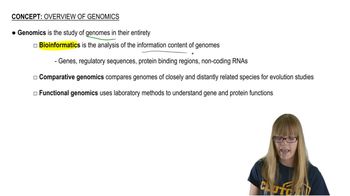
Comparative genomics involves analyzing and comparing the DNA sequences of different species to identify similarities and differences. This approach reveals conserved genes and sequences across humans and model organisms, indicating shared evolutionary ancestry and functional importance.
Recommended video:
Guided course
02:48
Genomics Overview

Gene Conservation and Homology

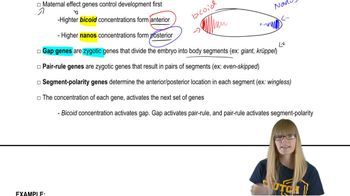
Gene conservation refers to genes that remain relatively unchanged across species due to essential biological functions. Homologous genes, derived from a common ancestor, often retain similar sequences and functions, providing evidence that humans and model organisms share key genetic components.
Recommended video:
Guided course
11:19
Segmentation Genes

Functional Studies Using Model Organisms

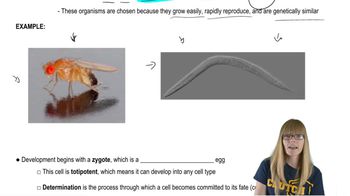
Model organisms like mice, fruit flies, and yeast are used to study gene function because many human genes have counterparts in these species. Experimental results showing similar gene roles and pathways support the idea that gene functions are conserved across species.
Recommended video:
Guided course
08:30
Genetics of Development