Pearson+ LogoPearson+ Logo
Ch. 20 - Quantitative Genetics and Multifactorial Traits
Klug - Essentials of Genetics 10th Edition
Klug10th EditionEssentials of GeneticsISBN: 9780135588789Not the one you use?Change textbook
Chapter 20, Problem 20a

In a population of 100 inbred, genotypically identical rice plants, variance for grain yield is 4.67. What is the heritability for yield? Would you advise a rice breeder to improve yield in this strain of rice plants by selection?

Verified step by step guidance
1
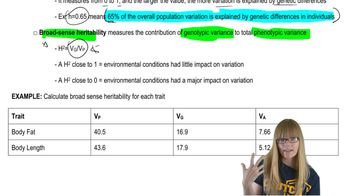
Understand the concept of heritability in the broad sense, which is the proportion of the total phenotypic variance that is due to genetic variance. It is given by the formula: \(H^2 = \frac{V_G}{V_P}\), where \(V_G\) is the genetic variance and \(V_P\) is the total phenotypic variance.
Note that the population consists of inbred, genotypically identical rice plants. Since all plants are genetically identical, the genetic variance \(V_G\) is effectively zero because there is no genetic variation among individuals.
Recognize that the observed variance in grain yield (4.67) must therefore be due to environmental variance \(V_E\), since \(V_P = V_G + V_E\) and \(V_G = 0\) in this case.
Calculate heritability using the formula \(H^2 = \frac{V_G}{V_P}\). Since \(V_G = 0\), heritability \(H^2\) will be zero, indicating no genetic contribution to the observed variance in yield.
Interpret the result: with zero heritability, selection for improved yield in this strain will not be effective because the variation in yield is not due to genetic differences. Advise the breeder accordingly.

Verified video answer for a similar problem:

This video solution was recommended by our tutors as helpful for the problem above.
Video duration:
1m
Was this helpful?

Key Concepts

Here are the essential concepts you must grasp in order to answer the question correctly.

Heritability in the Broad Sense

Heritability in the broad sense (H²) measures the proportion of total phenotypic variance in a trait that is due to genetic variance. It is calculated as the ratio of genetic variance to total phenotypic variance. In inbred, genotypically identical populations, genetic variance is minimal or zero, affecting heritability estimates.
Recommended video:
Guided course
07:04
Calculating Heritability

Phenotypic Variance and Genetic Variance

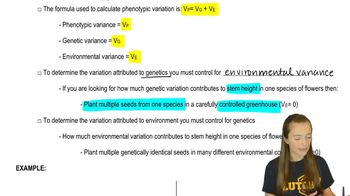
Phenotypic variance (Vp) is the total variation observed in a trait, arising from both genetic (Vg) and environmental (Ve) factors. In genetically identical populations, Vg is near zero, so Vp mainly reflects environmental variance. Understanding these components is essential to interpret heritability and predict response to selection.
Recommended video:
Guided course
08:34
Analyzing Trait Variance

Selection and Breeding Implications

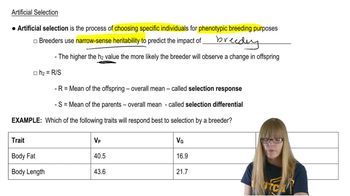
Selection effectiveness depends on heritability; high heritability means genetic factors strongly influence the trait, so selection can improve it. In populations with low or zero genetic variance, selection is unlikely to yield improvement, as observed variation is mostly environmental and not heritable.
Recommended video:
Guided course
04:15
Artificial Selection