
Pearson+ LogoPearson+ Logo
Ch. 20 - Quantitative Genetics and Multifactorial Traits
Klug - Essentials of Genetics 10th Edition
Klug10th EditionEssentials of GeneticsISBN: 9780135588789Not the one you use?Change textbook
Chapter 20, Problem 21

While most quantitative traits display continuous variation, there are others referred to as “threshold traits” that are distinguished by having a small number of discrete phenotypic classes. For example, Type 2 diabetes (adult-onset diabetes) is considered to be a polygenic trait, but demonstrates only two phenotypic classes: individuals who develop the disease and those who do not. Theorize how a threshold trait such as Type 2 diabetes may be under the control of many polygenes, but express a limited number of phenotypes.

Verified step by step guidance
1
Understand that threshold traits, like Type 2 diabetes, are influenced by multiple genes (polygenes) that each contribute a small effect to an underlying continuous variable called liability or risk.
Recognize that although the genetic and environmental factors create a continuous distribution of liability in the population, the phenotype is expressed in discrete classes based on whether an individual's liability exceeds a certain threshold.
Visualize the concept by imagining a bell-shaped curve representing the distribution of liability; individuals whose combined genetic and environmental risk surpasses the threshold develop the disease, while those below do not.
Consider that the threshold acts as a cutoff point, converting the continuous variation in liability into a binary phenotype (disease or no disease), which explains why only a few phenotypic classes are observed despite polygenic control.
Summarize that the polygenic inheritance creates a continuous risk spectrum, but the phenotype appears discrete because expression depends on crossing a liability threshold influenced by both genes and environment.

Key Concepts

Here are the essential concepts you must grasp in order to answer the question correctly.

Polygenic Inheritance

Polygenic inheritance involves multiple genes (polygenes) contributing additively to a single trait. Each gene has a small effect, and their combined influence results in a continuous range of phenotypes. This explains complex traits like height or skin color, where many genes interact to produce variation.
Recommended video:
Guided course
05:13
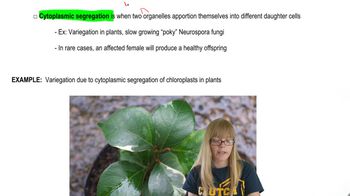
Organelle Inheritance

Threshold Traits

Threshold traits are traits that appear in discrete categories despite being influenced by multiple genes. Individuals have an underlying continuous liability or risk, but the phenotype manifests only when this liability crosses a certain threshold, resulting in distinct phenotypic classes.
Recommended video:
Guided course
13:40
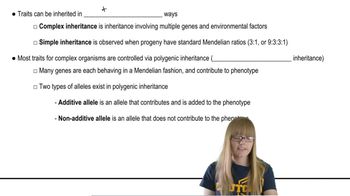
Traits and Variance

Liability-Threshold Model

The liability-threshold model explains how polygenic traits can produce discrete phenotypes. It posits an unobservable continuous liability influenced by genes and environment; when this liability exceeds a threshold, the trait is expressed. This model applies to diseases like Type 2 diabetes, where genetic risk accumulates until disease develops.
Recommended video: