Pearson+ LogoPearson+ Logo
Ch. 3 - Mendelian Genetics
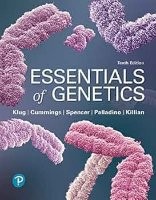
Klug - Essentials of Genetics 10th Edition
Klug10th EditionEssentials of GeneticsISBN: 9780135588789Not the one you use?Change textbook
Chapter 3, Problem 11

Distinguish between homozygosity and heterozygosity.

Verified step by step guidance
1
Understand that homozygosity and heterozygosity refer to the genetic composition of an organism at a specific gene locus.
Define homozygosity as the condition where an individual has two identical alleles for a particular gene, for example, \(AA\) or \(aa\).
Define heterozygosity as the condition where an individual has two different alleles for a particular gene, for example, \(Aa\).
Explain that homozygous individuals can be either dominant homozygous (\(AA\)) or recessive homozygous (\(aa\)), depending on the alleles present.
Highlight that heterozygous individuals (\(Aa\)) often show the dominant trait but carry one recessive allele, which can be passed to offspring.

Key Concepts

Here are the essential concepts you must grasp in order to answer the question correctly.

Homozygosity

Homozygosity refers to having two identical alleles for a specific gene on homologous chromosomes. An organism is homozygous at a gene locus if both inherited alleles are the same, such as AA or aa. This condition often results in consistent expression of a particular trait.
Recommended video:
Guided course
13:04
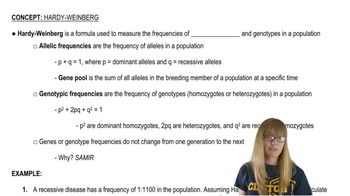
Hardy Weinberg

Heterozygosity

Heterozygosity occurs when an organism has two different alleles for a gene at the same locus, like Aa. This genetic variation can lead to dominant-recessive interactions, where the dominant allele typically determines the phenotype. Heterozygosity contributes to genetic diversity within populations.
Recommended video:

Alleles and Gene Loci

Alleles are different versions of a gene found at the same position (locus) on homologous chromosomes. Understanding alleles and their arrangement at gene loci is essential to distinguish between homozygosity and heterozygosity, as these terms describe the similarity or difference of alleles at a locus.
Recommended video:
Guided course
03:03
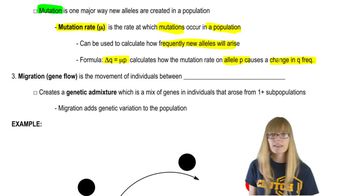
New Alleles and Migration