Pearson+ LogoPearson+ Logo
Ch. 3 - Mendelian Genetics
Klug - Essentials of Genetics 10th Edition
Klug10th EditionEssentials of GeneticsISBN: 9780135588789Not the one you use?Change textbook
Chapter 3, Problem 22b

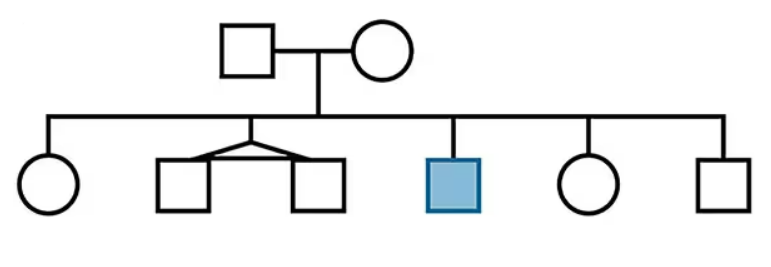
Draw all possible conclusions concerning the mode of inheritance of the trait portrayed in the following limited pedigree.
Pedigree chart showing two generations with one affected male indicated by a filled square among unaffected family members.

Verified step by step guidance
1
Step 1: Identify the affected and unaffected individuals in the pedigree. The filled square represents an affected male, while all other symbols (open squares and circles) represent unaffected individuals.
Step 2: Determine the generation and family relationships. The pedigree shows two generations: the first generation consists of unaffected parents, and the second generation includes their children, among whom one male is affected.
Step 3: Consider the mode of inheritance possibilities. Since only one male is affected and the parents are unaffected, consider whether the trait could be autosomal dominant, autosomal recessive, X-linked dominant, or X-linked recessive.
Step 4: Analyze the likelihood of each mode: - Autosomal dominant traits usually appear in every generation, so an affected child with unaffected parents is less likely. - Autosomal recessive traits can appear in offspring of unaffected parents if both are carriers. - X-linked recessive traits often affect males more frequently and can be passed from carrier mothers to sons. - X-linked dominant traits usually affect both males and females and often have affected mothers.
Step 5: Conclude that the trait is most consistent with an X-linked recessive inheritance pattern because only one male is affected, the parents are unaffected, and the trait appears only in a male child, which fits the pattern of X-linked recessive traits.

Verified video answer for a similar problem:

This video solution was recommended by our tutors as helpful for the problem above.
Video duration:
1m
Was this helpful?

Key Concepts

Here are the essential concepts you must grasp in order to answer the question correctly.

Pedigree Analysis

Pedigree analysis is a tool used to study the inheritance patterns of traits through generations in a family. It uses standardized symbols to represent individuals and their traits, helping to identify whether a trait is dominant, recessive, autosomal, or sex-linked.
Recommended video:
Guided course
01:59
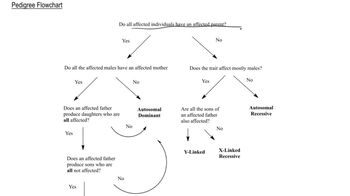
Pedigree Flowchart

Modes of Inheritance

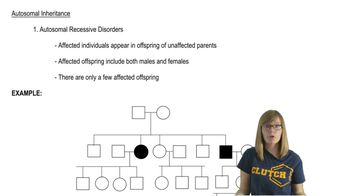
Modes of inheritance describe how traits are passed from parents to offspring, including autosomal dominant, autosomal recessive, X-linked dominant, and X-linked recessive patterns. Recognizing these patterns in pedigrees helps determine the genetic basis of a trait.
Recommended video:
Guided course
05:13
Organelle Inheritance

Interpretation of Affected and Unaffected Individuals

In pedigrees, affected individuals are typically shaded, while unaffected are unshaded. Analyzing the distribution of affected individuals across generations and sexes provides clues about the trait's inheritance, such as whether it skips generations or affects one sex more frequently.
Recommended video:
Guided course
09:08
Autosomal Pedigrees