
Pearson+ LogoPearson+ Logo
Ch. 4 - Modification of Mendelian Ratios
Klug - Essentials of Genetics 10th Edition
Klug10th EditionEssentials of GeneticsISBN: 9780135588789Not the one you use?Change textbook
Chapter 4, Problem 33

In four o’clock plants, many flower colors are observed. In a cross involving two true-breeding strains, one crimson and the other white, all of the generation were rose color. In the , four new phenotypes appeared along with the and parental colors. The following ratio was obtained:
Propose an explanation for the inheritance of these flower colors.

Verified step by step guidance
1
Identify the type of inheritance pattern based on the given information: two true-breeding parental strains (crimson and white) produce all rose-colored offspring in the F1 generation, indicating incomplete dominance where the heterozygote shows an intermediate phenotype.
Recognize that in the F2 generation, the appearance of the two parental phenotypes (crimson and white) along with the intermediate rose color and four additional phenotypes suggests multiple alleles or gene interactions affecting flower color.
Consider that the four new phenotypes could result from combinations of alleles at one or more loci, possibly involving codominance, incomplete dominance, or epistasis, which create a variety of flower colors beyond the simple parental and F1 phenotypes.
Use the observed phenotypic ratio in the F2 generation to hypothesize the number of alleles or genes involved and their mode of interaction, such as multiple alleles with incomplete dominance or a polygenic trait with additive effects.
Formulate a genetic model explaining the inheritance pattern, such as a single gene with multiple alleles showing incomplete dominance, or two interacting genes producing a range of phenotypes, and predict the expected genotypic and phenotypic ratios accordingly.

Key Concepts

Here are the essential concepts you must grasp in order to answer the question correctly.

Incomplete Dominance

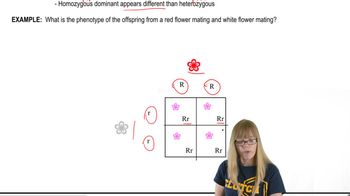
Incomplete dominance occurs when neither allele is completely dominant, resulting in a heterozygous phenotype that is intermediate between the two homozygous parents. In four o’clock plants, crossing crimson and white flowers produces rose-colored offspring, demonstrating this blending effect.
Recommended video:
Guided course
04:37
Variations on Dominance

Multiple Alleles and Gene Interaction

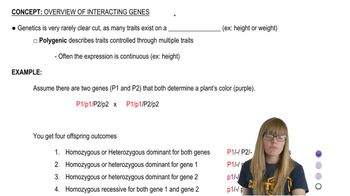
Multiple alleles refer to the presence of more than two allele forms for a gene, which can interact to produce diverse phenotypes. In four o’clock plants, different combinations of alleles can lead to various flower colors beyond the parental types, explaining the appearance of new phenotypes in later generations.
Recommended video:
Guided course
07:56
Interacting Genes Overview

Mendelian Inheritance and Phenotypic Ratios

Mendelian inheritance principles describe how alleles segregate and assort independently, producing predictable phenotypic ratios. The observed ratio with multiple flower colors suggests a more complex inheritance pattern involving incomplete dominance and possibly epistasis or gene interaction.
Recommended video:
Guided course
10:48
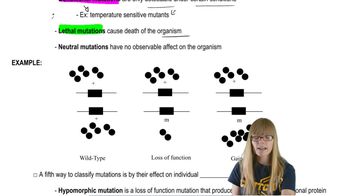
Mutations and Phenotypes