Pearson+ LogoPearson+ Logo
Ch. 4 - Modification of Mendelian Ratios
Klug - Essentials of Genetics 10th Edition
Klug10th EditionEssentials of GeneticsISBN: 9780135588789Not the one you use?Change textbook
Chapter 4, Problem 32b

Students taking a genetics exam were expected to answer the following question by converting data to a “meaningful ratio” and then solving the problem. The instructor assumed that the final ratio would reflect two gene pairs, and most correct answers did. Here is the exam question:
“Flowers may be white, orange, or brown. When plants with white flowers are crossed with plants with brown flowers, all the flowers are white. For flowers, the following data were obtained:
<IMAGE>
Convert the data to a meaningful ratio that allows you to explain the inheritance of color. Determine the number of genes involved and the genotypes that yield each phenotype.”
b. A number of students failed to reduce the ratio for two gene pairs as described above and solved the problem using three gene pairs. When examined carefully, their solution was deemed a valid response by the instructor. Solve the problem using three gene pairs.

Verified step by step guidance
1
Step 1: Understand the phenotypes and their inheritance pattern. The problem states that crossing white-flowered plants with brown-flowered plants results in all white flowers in the F1 generation, indicating that white is dominant over brown or that brown is recessive or masked in some way. The presence of three flower colors (white, orange, brown) suggests multiple genes may be involved, possibly with epistasis or interaction effects.
Step 2: Convert the raw data into a ratio of phenotypes. Count the number of plants with each flower color (white, orange, brown) and express these counts as a ratio. Then, reduce this ratio to its simplest form to identify a meaningful pattern that corresponds to genetic inheritance ratios.
Step 3: For the two-gene pair model, interpret the ratio in terms of classic Mendelian dihybrid crosses. For example, a 9:3:3:1 or modified ratio might explain the phenotypes if two genes interact. Assign genotypes to each phenotype based on dominant and recessive alleles at each gene locus.
Step 4: For the three-gene pair model, extend the analysis by considering three independent gene pairs, each with dominant and recessive alleles. Use the phenotype ratio obtained to match expected ratios from trihybrid crosses (e.g., 27:9:9:9:3:3:3:1 or modified forms). Determine which combinations of genotypes correspond to each flower color phenotype.
Step 5: Summarize the genotypes for each phenotype under the three-gene model. Identify which alleles at each gene locus contribute to white, orange, or brown flowers, considering possible dominance, recessiveness, and gene interactions. This will explain the inheritance pattern and justify the observed phenotype ratios.

Key Concepts

Here are the essential concepts you must grasp in order to answer the question correctly.

Mendelian Inheritance and Gene Pairs

Mendelian inheritance explains how traits are passed from parents to offspring through discrete gene pairs. Each gene pair consists of two alleles, which can be dominant or recessive, influencing the phenotype. Understanding how two or more gene pairs interact helps predict offspring ratios and explains complex inheritance patterns.
Recommended video:
Guided course
09:09
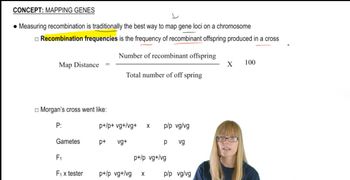
Mapping Genes

Phenotypic Ratios and Their Interpretation

Phenotypic ratios represent the proportion of different observable traits in offspring from a genetic cross. Converting raw data into meaningful ratios allows identification of the number of genes involved and their interaction type (e.g., dominance, epistasis). Accurate ratio reduction is essential for interpreting genetic crosses correctly.
Recommended video:
Guided course
10:48
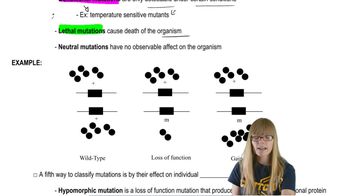
Mutations and Phenotypes

Epistasis and Multi-Gene Interactions

Epistasis occurs when one gene pair masks or modifies the expression of another, complicating simple Mendelian ratios. Multi-gene interactions, involving two or more gene pairs, can produce novel phenotypes and altered ratios. Recognizing these interactions is crucial when solving problems involving more than one gene pair, such as the three-gene pair solution in this question.
Recommended video:
Guided course
07:56
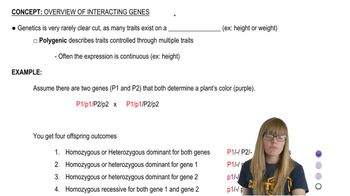
Interacting Genes Overview