Pearson+ LogoPearson+ Logo
Ch. 4 - Modification of Mendelian Ratios
Klug - Essentials of Genetics 10th Edition
Klug10th EditionEssentials of GeneticsISBN: 9780135588789Not the one you use?Change textbook
Chapter 4, Problem 25b

Pigment in mouse fur is only produced when the C allele is present. Individuals of the cc genotype are white. If color is present, it may be determined by the A, a alleles. AA or Aa results in agouti color, while aa results in black coats. In three crosses between agouti females whose genotypes were unknown and males of the aacc genotype, the following phenotypic ratios were obtained:
(1) 8 agouti
(2) 9 agouti
(3) 4 agouti, 8 white 10 black, 5 black, 10 white

Verified step by step guidance
1
Step 1: Understand the genetic system described. The C allele controls pigment production: C_ (CC or Cc) produces pigment, while cc results in white fur. Among pigmented mice (C_), the A locus determines color: AA or Aa gives agouti, and aa gives black.
Step 2: Analyze the males' genotype: aacc. Since they are cc, they are white and do not produce pigment. Their genotype is homozygous recessive at both loci.
Step 3: Since the males are aacc, all offspring will inherit a c allele from the father, making their genotype at the C locus at least c_. The mother’s genotype is unknown but must have at least one C allele to produce pigment in offspring.
Step 4: For each cross, use the phenotypic ratios to deduce the mother's genotype. For example, if all offspring are pigmented (agouti), the mother is likely CC or Cc and AA or Aa. If white offspring appear, the mother may be Cc, allowing cc offspring (white) to appear.
Step 5: Use Punnett squares for each locus separately (C and A) to predict offspring genotypes and phenotypes. Combine these to match the observed ratios, which will help infer the mother's genotype in each cross.

Verified video answer for a similar problem:

This video solution was recommended by our tutors as helpful for the problem above.
Video duration:
2m
Was this helpful?

Key Concepts

Here are the essential concepts you must grasp in order to answer the question correctly.

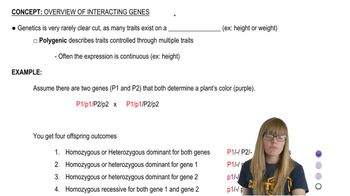
Epistasis and Gene Interaction

Epistasis occurs when one gene masks or modifies the expression of another gene. In this question, the C allele controls pigment production, and its recessive form (cc) results in white fur regardless of the A locus genotype. Understanding how the C locus epistatically affects the A locus is essential to interpret the phenotypic ratios.
Recommended video:
Guided course
07:56
Interacting Genes Overview

Mendelian Inheritance and Genotypic Ratios

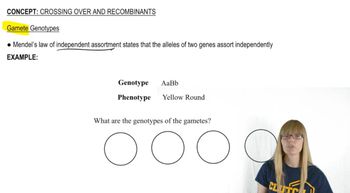
Mendelian inheritance principles explain how alleles segregate and assort independently during gamete formation. Knowing how to predict offspring genotypes and phenotypes from parental crosses, especially with dominant and recessive alleles, helps analyze the given crosses and their resulting phenotypic ratios.
Recommended video:
Guided course
07:52
Gamete Genotypes

Phenotypic Ratios and Genotype Inference

Phenotypic ratios observed in offspring can be used to infer the unknown parental genotypes. By comparing expected ratios from different genotype combinations with observed data, one can deduce the likely genotypes of the agouti females, considering the interaction between the A and C loci.
Recommended video:
Guided course
07:52
Gamete Genotypes
Related Practice
Textbook Question

Horses can be cremello (a light cream color), chestnut (a brownish color), or palomino (a golden color with white in the horse's tail and mane). Of these phenotypes, only palominos never breed true.

From the results given above, determine the mode of inheritance by assigning gene symbols and indicating which genotypes yield which phenotypes.

1086
views
Textbook Question

Horses can be cremello (a light cream color), chestnut (a brownish color), or palomino (a golden color with white in the horse's tail and mane). Of these phenotypes, only palominos never breed true.

Predict the F1 and F2 results of many initial matings between cremello and chestnut horses.

546
views
Textbook Question

Pigment in mouse fur is only produced when the C allele is present. Individuals of the cc genotype are white. If color is present, it may be determined by the A, a alleles. AA or Aa results in agouti color, while aa results in black coats. What F₁ and F₂ genotypic and phenotypic ratios are obtained from a cross between AACC and aacc mice?

751
views
Textbook Question

Five human matings (1–5), identified by both maternal and paternal phenotypes for ABO and MN blood-group antigen status, are shown on the left side of the following table:

Each mating resulted in one of the five offspring shown in the right-hand column (a–e). Match each offspring with one correct set of parents, using each parental set only once. Is there more than one set of correct answers?

695
views
Textbook Question

Two mothers give birth to sons at the same time at a busy urban hospital. The son of mother 1 is afflicted with hemophilia, a disease caused by an X-linked recessive allele. Neither parent has the disease. Mother 2 has a normal son, despite the fact that the father has hemophilia. Several years later, couple 1 sues the hospital, claiming that these two newborns were swapped in the nursery following their birth. As a genetic counselor, you are called to testify. What information can you provide the jury concerning the allegation?

544
views
Textbook Question

In Dexter and Kerry cattle, animals may be polled (hornless) or horned. The Dexter animals have short legs, whereas the Kerry animals have long legs. When many offspring were obtained from matings between polled Kerrys and horned Dexters, half were found to be polled Dexters and half polled Kerrys. When these two types of F₁ cattle were mated to one another, the following F₂ data were obtained:

3/8 polled Dexters

3/8 polled Kerrys

1/8 horned Dexters

1/8 horned Kerrys

A geneticist was puzzled by these data and interviewed farmers who had bred these cattle for decades. She learned that Kerrys were true breeding. Dexters, on the other hand, were not true breeding and never produced as many offspring as Kerrys. Provide a genetic explanation for these observations.

727
views