Pearson+ LogoPearson+ Logo
Ch. 5 - Sex Determination and Sex Chromosomes
Klug - Essentials of Genetics 10th Edition
Klug10th EditionEssentials of GeneticsISBN: 9780135588789Not the one you use?Change textbook
Chapter 5, Problem 22

What does the apparent need for dosage compensation mechanisms suggest about the expression of genetic information in normal diploid individuals?

Verified step by step guidance
1
Understand that dosage compensation mechanisms are biological processes that balance the expression of genes between individuals with different numbers of sex chromosomes, such as males (XY) and females (XX).
Recognize that in normal diploid individuals, each gene is typically present in two copies (alleles), one from each parent, and these copies are usually expressed at similar levels.
Consider that the need for dosage compensation implies that without such mechanisms, the difference in gene copy number (for example, between the single X chromosome in males and two X chromosomes in females) would lead to unequal gene expression levels.
Conclude that this suggests gene expression is sensitive to gene dosage, meaning the amount of gene product produced depends on the number of gene copies present.
Therefore, dosage compensation mechanisms are necessary to equalize gene expression levels, ensuring that genetic information is expressed in a balanced way despite differences in chromosome number.

Key Concepts

Here are the essential concepts you must grasp in order to answer the question correctly.

Dosage Compensation

Dosage compensation is a biological mechanism that balances the expression of genes between individuals with differing numbers of sex chromosomes, such as males (XY) and females (XX). It ensures that genes on the sex chromosomes are expressed at similar levels despite differences in chromosome number, preventing harmful imbalances in protein production.
Recommended video:
Guided course
00:52
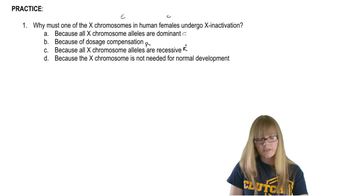
Purpose of X Inactivation

Gene Expression Regulation in Diploids

In diploid organisms, each gene typically has two copies (alleles), one from each parent. Proper regulation of gene expression is crucial to maintain cellular function and organismal development, as imbalances in gene dosage can lead to abnormal phenotypes or diseases.
Recommended video:
Guided course
27:36
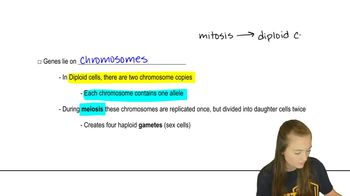
Diploid Genetics

Impact of Gene Dosage on Phenotype

Gene dosage refers to the number of copies of a gene present in a cell. Variations in gene dosage can affect the amount of gene product produced, influencing phenotype. Dosage compensation mechanisms highlight the importance of maintaining balanced gene expression to avoid detrimental effects caused by over- or under-expression.
Recommended video:
Guided course
10:48
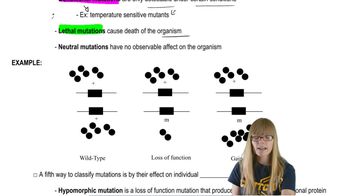
Mutations and Phenotypes
Related Practice
Textbook Question

Can the Lyon hypothesis be tested in a human female who is homozygous for one allele of the X-linked G6PD gene? Why, or why not?

573
views
Textbook Question

Predict the potential effect of the Lyon hypothesis on the retina of a human female heterozygous for the X-linked red-green color blindness trait.

684
views
Textbook Question

Cat breeders are aware that kittens expressing the X-linked calico coat pattern and tortoiseshell pattern are almost invariably females. Why are they certain of this?

491
views
Textbook Question

In mice, the Sry gene is located on the Y chromosome very close to one of the pseudoautosomal regions that pairs with the X chromosome during male meiosis. Given this information, propose a model to explain the generation of unusual males who have two X chromosomes (with an Sry-containing piece of the Y chromosome attached to one X chromosome).

1026
views
Textbook Question

The genes encoding the red- and green-color-detecting proteins of the human eye are located next to one another on the X chromosome and probably evolved from a common ancestral pigment gene. The two proteins demonstrate 76 percent homology in their amino acid sequences. A normal-visioned woman (with both genes present on each of her two X chromosomes) has a red-color-blind son who was shown to have one copy of the green-detecting gene and no copies of the red-detecting gene. Devise an explanation for these observations at the chromosomal level (involving meiosis).

597
views
Textbook Question

In mice, the X-linked dominant mutation Testicular feminization (Tfm) eliminates the normal response to the testicular hormone testosterone during sexual differentiation. An XY mouse bearing the Tfm allele on the X chromosome develops testes, but no further male differentiation occurs—the external genitalia of such an animal are female. From this information, what might you conclude about the role of the Tfm gene product and the X and Y chromosomes in sex determination and sexual differentiation in mammals? Can you devise an experiment, assuming you can 'genetically engineer' the chromosomes of mice, to test and confirm your explanation?

748
views