
Pearson+ LogoPearson+ Logo
Ch. 9 - DNA Structure and Analysis
Klug - Essentials of Genetics 10th Edition
Klug10th EditionEssentials of GeneticsISBN: 9780135588789Not the one you use?Change textbook
Chapter 9, Problem 32

During gel electrophoresis, DNA molecules can easily be separated according to size because all DNA molecules have the same charge-to-mass ratio and the same shape (long rod). Would you expect RNA molecules to behave in the same manner as DNA during gel electrophoresis? Why or why not?

Verified step by step guidance
1
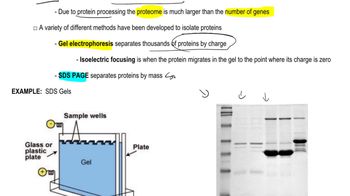
Recall that gel electrophoresis separates molecules primarily based on size because the molecules move through a gel matrix under an electric field, and their migration depends on their charge-to-mass ratio and shape.
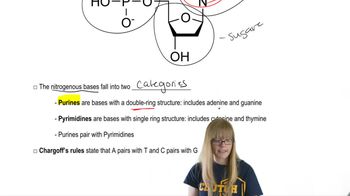
Understand that DNA molecules have a uniform charge-to-mass ratio due to their consistent phosphate backbone and a relatively uniform shape (long rods), which allows size to be the main factor affecting their movement through the gel.
Consider the structure of RNA molecules: although RNA also has a phosphate backbone giving it a negative charge, RNA molecules often fold into complex secondary and tertiary structures, unlike the relatively uniform shape of DNA.
Because RNA molecules can have varied shapes and folding patterns, their effective size and shape during electrophoresis can differ, which affects their migration through the gel differently than DNA.
Therefore, RNA molecules do not behave exactly like DNA during gel electrophoresis because their variable shapes and structures influence their movement, making size separation less straightforward compared to DNA.

Verified video answer for a similar problem:

This video solution was recommended by our tutors as helpful for the problem above.
Video duration:
2m
Was this helpful?

Key Concepts

Here are the essential concepts you must grasp in order to answer the question correctly.

Charge-to-Mass Ratio of Nucleic Acids

DNA molecules have a uniform negative charge due to their phosphate backbone, resulting in a consistent charge-to-mass ratio. This uniformity allows DNA fragments to separate primarily based on size during gel electrophoresis. RNA also has a phosphate backbone, but structural differences can affect its charge distribution.
Recommended video:

Molecular Structure and Shape of DNA vs. RNA

DNA typically exists as a long, double-stranded helix with a relatively uniform rod-like shape, facilitating predictable migration in gels. RNA molecules are often single-stranded and can fold into complex secondary and tertiary structures, which influence their shape and mobility during electrophoresis.
Recommended video:
Guided course
06:25
DNA Structure

Effect of Secondary Structure on Electrophoretic Mobility

RNA's ability to form intramolecular base pairing creates secondary structures like hairpins, altering its effective size and shape. These structures can slow or irregularly affect RNA migration in gels, making its separation less dependent solely on length compared to DNA.
Recommended video:
Guided course
03:38
Maternal Effect
Related Practice
Textbook Question

Newsdate: March 1, 2030. A unique creature has been discovered during exploration of outer space. Recently, its genetic material has been isolated and analyzed. This material is similar in some ways to DNA in its chemical makeup. It contains in abundance the 4-carbon sugar erythrose and a molar equivalent of phosphate groups. In addition, it contains six nitrogenous bases: adenine (A), guanine (G), thymine (T), cytosine (C), hypoxanthine (H), and xanthine (X). These bases exist in the following relative proportions:

A =T = H and C = G = X

X-ray diffraction studies have established a regularity in the molecule and a constant diameter of about 30 Å. Together, these data have suggested a model for the structure of this molecule.

Propose a general model of this molecule. Describe it briefly.

541
views
Textbook Question

Newsdate: March 1, 2030. A unique creature has been discovered during exploration of outer space. Recently, its genetic material has been isolated and analyzed. This material is similar in some ways to DNA in its chemical makeup. It contains in abundance the 4-carbon sugar erythrose and a molar equivalent of phosphate groups. In addition, it contains six nitrogenous bases: adenine (A), guanine (G), thymine (T), cytosine (C), hypoxanthine (H), and xanthine (X). These bases exist in the following relative proportions:

A =T = H and C = G = X

X-ray diffraction studies have established a regularity in the molecule and a constant diameter of about 30 Å. Together, these data have suggested a model for the structure of this molecule.

What base-pairing properties must exist for H and for X in the model?

531
views
Textbook Question

Newsdate: March 1, 2030. A unique creature has been discovered during exploration of outer space. Recently, its genetic material has been isolated and analyzed. This material is similar in some ways to DNA in its chemical makeup. It contains in abundance the 4-carbon sugar erythrose and a molar equivalent of phosphate groups. In addition, it contains six nitrogenous bases: adenine (A), guanine (G), thymine (T), cytosine (C), hypoxanthine (H), and xanthine (X). These bases exist in the following relative proportions:

A =T = H and C = G = X

X-ray diffraction studies have established a regularity in the molecule and a constant diameter of about 30 Å. Together, these data have suggested a model for the structure of this molecule.

Given the constant diameter of 30 Å, do you think that either (i) both H and X are purines or both pyrimidines, or (ii) one is a purine and one is a pyrimidine?

593
views