Pearson+ LogoPearson+ Logo
Ch. 9 - DNA Structure and Analysis
Klug - Essentials of Genetics 10th Edition
Klug10th EditionEssentials of GeneticsISBN: 9780135588789Not the one you use?Change textbook
Chapter 9, Problem 28

One of the most common spontaneous lesions that occurs in DNA under physiological conditions is the hydrolysis of the amino group of cytosine, converting the cytosine to uracil. What would be the effect on DNA structure of a uracil group replacing cytosine?

Verified step by step guidance
1
Understand that cytosine normally pairs with guanine in DNA through three hydrogen bonds, maintaining the DNA double helix structure.
Recognize that when cytosine undergoes deamination, it is converted into uracil, which is not a normal base in DNA but is normally found in RNA.
Consider that uracil pairs preferentially with adenine through two hydrogen bonds, unlike cytosine which pairs with guanine.
Analyze how the presence of uracil in DNA would lead to a mismatch during DNA replication, potentially causing a C-G to T-A transition mutation if not repaired.
Conclude that the incorporation of uracil disrupts the normal base pairing and can lead to mutations, which is why cells have repair mechanisms like uracil-DNA glycosylase to remove uracil from DNA.

Verified video answer for a similar problem:

This video solution was recommended by our tutors as helpful for the problem above.
Video duration:
3m
Was this helpful?

Key Concepts

Here are the essential concepts you must grasp in order to answer the question correctly.

Spontaneous DNA Lesions and Deamination

Spontaneous DNA lesions are natural chemical changes that occur without external influence. Deamination is the removal of an amino group from a base, such as cytosine converting to uracil, which alters the base's identity and can lead to mutations if unrepaired.
Recommended video:
Guided course
09:52
Spontaneous Mutations

Base Pairing and DNA Structure

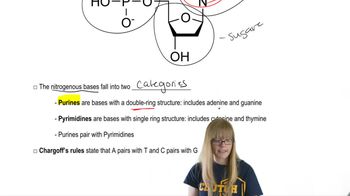
DNA structure relies on specific base pairing: cytosine pairs with guanine via three hydrogen bonds. Replacing cytosine with uracil disrupts this pairing because uracil pairs with adenine, potentially causing mismatches and destabilizing the double helix.
Recommended video:
Guided course
06:25
DNA Structure

DNA Repair Mechanisms for Uracil

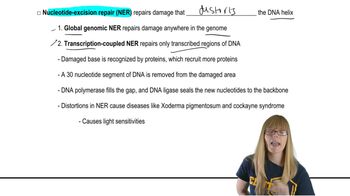
Cells have repair systems like base excision repair to recognize and remove uracil in DNA, preventing mutations. Uracil-DNA glycosylase excises uracil bases, maintaining DNA integrity by restoring correct cytosine-guanine pairs.
Recommended video:
Guided course
05:44
Repair Pathways
Related Practice
Textbook Question

A primitive eukaryote was discovered that displayed a unique nucleic acid as its genetic material. Analysis provided the following information:

A major hyperchromic shift is evident upon heating and monitoring UV absorption at 260 nm.

437
views
Textbook Question

A primitive eukaryote was discovered that displayed a unique nucleic acid as its genetic material. Analysis provided the following information:

Base-composition analysis reveals four bases in the following proportions: Adenine = 8%; Guanine = 37%; Xanthine = 37%; Hypoxanthine = 18%

409
views
Textbook Question

A primitive eukaryote was discovered that displayed a unique nucleic acid as its genetic material. Analysis provided the following information:

About 75 percent of the sugars are deoxyribose, while 25 percent are ribose.

Postulate a model for the structure of this molecule that is consistent with the foregoing observations.

405
views
Textbook Question

In some organisms, cytosine is methylated at carbon 5 of the pyrimidine ring after it is incorporated into DNA. If a 5-methyl cytosine molecule is then hydrolyzed, what base will be generated?

642
views
Textbook Question

Newsdate: March 1, 2030. A unique creature has been discovered during exploration of outer space. Recently, its genetic material has been isolated and analyzed. This material is similar in some ways to DNA in its chemical makeup. It contains in abundance the 4-carbon sugar erythrose and a molar equivalent of phosphate groups. In addition, it contains six nitrogenous bases: adenine (A), guanine (G), thymine (T), cytosine (C), hypoxanthine (H), and xanthine (X). These bases exist in the following relative proportions:

A =T = H and C = G = X

X-ray diffraction studies have established a regularity in the molecule and a constant diameter of about 30 Å. Together, these data have suggested a model for the structure of this molecule.

Propose a general model of this molecule. Describe it briefly.

541
views
Textbook Question

Newsdate: March 1, 2030. A unique creature has been discovered during exploration of outer space. Recently, its genetic material has been isolated and analyzed. This material is similar in some ways to DNA in its chemical makeup. It contains in abundance the 4-carbon sugar erythrose and a molar equivalent of phosphate groups. In addition, it contains six nitrogenous bases: adenine (A), guanine (G), thymine (T), cytosine (C), hypoxanthine (H), and xanthine (X). These bases exist in the following relative proportions:

A =T = H and C = G = X

X-ray diffraction studies have established a regularity in the molecule and a constant diameter of about 30 Å. Together, these data have suggested a model for the structure of this molecule.

What base-pairing properties must exist for H and for X in the model?
531
views