Skip to main content
GOB Chemistry
My Course
Learn
Exam Prep
AI Tutor
Study Guides
Textbook Solutions
Flashcards
Explore
Try the app
My Course
Learn
Exam Prep
AI Tutor
Study Guides
Textbook Solutions
Flashcards
Explore
Try the app
Back
Alcohol Reactions: Dehydration Reactions definitions
You can tap to flip the card.
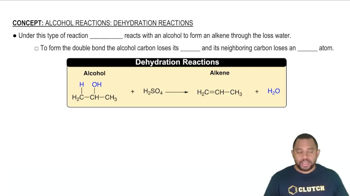
Dehydration Reaction
You can tap to flip the card.
👆
Dehydration Reaction
A process where an alcohol and sulfuric acid interact, resulting in the removal of water and formation of an alkene.
Track progress
Control buttons has been changed to "navigation" mode.
1/13
Related flashcards
Related practice
Recommended videos
Alcohol Reactions: Dehydration Reactions quiz
Alcohol Reactions: Dehydration Reactions
15 Terms
Alcohol Reactions: Dehydration Reactions
14. Compounds with Oxygen or Sulfur
6 problems
Topic
Jules
Intro to Redox Reactions
14. Compounds with Oxygen or Sulfur
3 problems
Topic
Ernest
14. Compounds with Oxygen or Sulfur
7 topics
15 problems
Chapter
Jules
Guided course
1:30
Alcohol Reactions: Dehydration Reactions Concept 1
1635
views
6
rank
Guided course
1:24
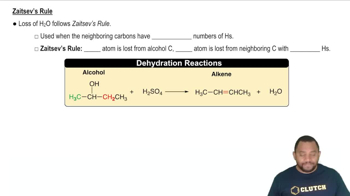
Zaitsev’s Rule Concept 2
1696
views
5
rank
Guided course
1:13
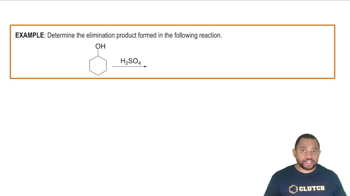
Alcohol Reactions Dehydration Reactions Example 1
1571
views
10
rank
Terms in this set (13)
Hide definitions
Dehydration Reaction
A process where an alcohol and sulfuric acid interact, resulting in the removal of water and formation of an alkene.
Sulfuric Acid
A strong acid, H2SO4, used to initiate the removal of water from alcohols during alkene formation.
Alcohol
An organic compound containing an OH group, serving as the starting material in dehydration to form alkenes.
Alkene
A hydrocarbon product featuring a carbon-carbon double bond, formed after water is removed from an alcohol.
Alcohol Carbon
The specific carbon atom in an alcohol molecule directly bonded to the OH group, which loses this group during dehydration.
Neighboring Carbon
A carbon atom adjacent to the alcohol carbon, which loses a hydrogen atom during the dehydration process.
Double Bond
A chemical bond formed between two carbons after both lose atoms, resulting in the characteristic structure of alkenes.
Water
A molecule, H2O, eliminated from the reactants during the transformation of alcohol to alkene.
Zaitsev's Rule
A guideline stating that the hydrogen is removed from the neighboring carbon with fewer hydrogens during dehydration.
Symmetrical Reaction
A scenario where neighboring carbons are identical, allowing hydrogen loss from either side during dehydration.
Methyl Group
A -CH3 group, often found as a neighboring carbon in alcohols undergoing dehydration.
Elimination Reaction
A broader reaction type where atoms are removed from a molecule, as seen in alcohol dehydration to form alkenes.
CH2 Group
A methylene unit, which may lose a hydrogen during dehydration, affecting the position of the new double bond.
 BackBack

 1:30
1:30