Skip to main content
GOB Chemistry
My Course
Learn
Exam Prep
AI Tutor
Study Guides
Textbook Solutions
Flashcards
Explore
Try the app
My Course
Learn
Exam Prep
AI Tutor
Study Guides
Textbook Solutions
Flashcards
Explore
Try the app
Back
Alcohol Reactions: Oxidation Reactions definitions
You can tap to flip the card.
Oxidizing Agent
You can tap to flip the card.
👆
Oxidizing Agent
Substance responsible for increasing the number of carbon-oxygen bonds in alcohols during chemical transformation.
Track progress
Control buttons has been changed to "navigation" mode.
1/13
Related flashcards
Related practice
Recommended videos
Alcohol Reactions: Oxidation Reactions quiz
Alcohol Reactions: Oxidation Reactions
15 Terms
Alcohol Reactions: Oxidation Reactions
14. Compounds with Oxygen or Sulfur
5 problems
Topic
Jules
Reactions of Thiols
14. Compounds with Oxygen or Sulfur
2 problems
Topic
Jules
14. Compounds with Oxygen or Sulfur
7 topics
15 problems
Chapter
Jules
Guided course
1:32
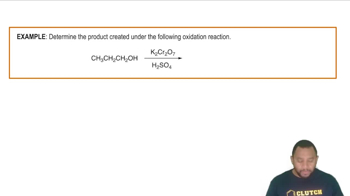
Alcohol Reactions Oxidation Reactions Example 1
1397
views
2
rank
Guided course
1:49
Alcohol Reactions: Oxidation Concept 1
1519
views
8
rank
Terms in this set (13)
Hide definitions
Oxidizing Agent
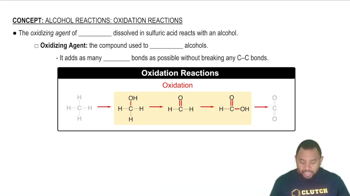
Substance responsible for increasing the number of carbon-oxygen bonds in alcohols during chemical transformation.
Sodium Dichromate
Group 1A compound used in acidic solution to facilitate the oxidation of alcohols in organic reactions.
Potassium Dichromate
Alternative to sodium-based oxidizer, providing the dichromate ion for alcohol oxidation in acidic medium.
Sulfuric Acid
Acidic solvent that enables dichromate compounds to react efficiently with alcohols during oxidation.
Carbon-Oxygen Bond
Connection formed during oxidation, increasing the oxygen content of organic molecules without altering carbon chains.
Carbon-Carbon Bond
Structural link in organic molecules that remains intact during alcohol oxidation processes.
Alcohol
Organic compound containing a hydroxyl group, serving as the starting material for oxidation to carbonyl derivatives.
Carbonyl Compound
Molecule featuring a carbon double-bonded to oxygen, produced from alcohol oxidation and classified as aldehyde or ketone.
Aldehyde
Carbonyl-containing product formed from primary alcohol oxidation, with the carbonyl group at a molecule's end.
Ketone
Carbonyl-containing product from secondary alcohol oxidation, with the carbonyl group within the carbon chain.
Carboxylic Acid
Highly oxidized organic compound with both a carbonyl and hydroxyl group on the same carbon, formed from further oxidation.
Functional Group
Specific atom arrangement in organic molecules, such as hydroxyl or carbonyl, that determines chemical reactivity.
Group 1A Element
Category in the periodic table including sodium and potassium, whose salts are used in dichromate oxidizers.
 BackBack
 1:32
1:32