Skip to main content
GOB Chemistry
My Course
Learn
Exam Prep
AI Tutor
Study Guides
Textbook Solutions
Flashcards
Explore
Try the app
My Course
Learn
Exam Prep
AI Tutor
Study Guides
Textbook Solutions
Flashcards
Explore
Try the app
Back
Amine Reactions definitions
You can tap to flip the card.
Amine
You can tap to flip the card.
👆
Amine
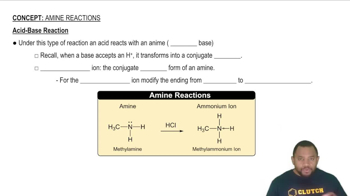
A molecule containing a nitrogen atom with a lone pair, typically acting as a weak base in chemical reactions.
Track progress
Control buttons has been changed to "navigation" mode.
1/13
Related flashcards
Related practice
Recommended videos
Amine Reactions quiz
Amine Reactions
15 Terms
Amine Reactions
17. Amines
7 problems
Topic
Ernest
Functional Group Priorities
17. Amines
4 problems
Topic
Jules
17. Amines - Part 1 of 2
4 topics
12 problems
Chapter
Jules
17. Amines - Part 2 of 2
1 topic
2 problems
Chapter
Guided course
1:05
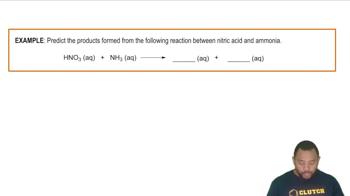
Acid-Base Reaction Example 1
3268
views
1
rank
Guided course
1:32
Acid-Base Reaction Concept 1
3263
views
1
rank
Terms in this set (13)
Hide definitions
Amine
A molecule containing a nitrogen atom with a lone pair, typically acting as a weak base in chemical reactions.
Acid-Base Reaction
A process where a proton is transferred from an acid to a base, often resulting in the formation of a conjugate acid and base.
Weak Base
A substance that partially accepts protons in solution, often characterized by the presence of a nitrogen atom with a lone pair.
Conjugate Acid
The species formed when a base gains a proton, often resulting in a change in charge and bonding.
Ammonium Ion
A positively charged nitrogen species formed when an amine accepts a proton and forms four bonds.
Methylamine
A simple amine with a methyl group attached to nitrogen, serving as a common example in acid-base reactions.
Hydrochloric Acid
A strong acid that donates a proton to bases, frequently used to illustrate acid-base interactions with amines.
Proton
A hydrogen ion (H+) transferred during acid-base reactions, responsible for changes in charge and bonding.
Nitrogen
An element central to amines, capable of forming three or four bonds depending on its charge state.
Methyl Ammonium Ion
A product formed when methylamine accepts a proton, resulting in a positively charged nitrogen with four bonds.
Charge
An electrical property that changes when atoms gain or lose protons, such as nitrogen becoming positive after protonation.
Bond
A connection between atoms, with nitrogen in amines forming three in the neutral state and four when protonated.
Bronsted-Lowry Definition
A concept describing acids as proton donors and bases as proton acceptors in chemical reactions.
 BackBack

 1:05
1:05