Back

Atomic Theory definitions

Control buttons has been changed to "navigation" mode.
1/15
  • Atom

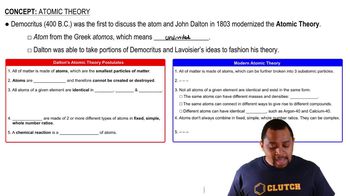
    Smallest unit of matter retaining chemical properties, once thought indivisible but now known to contain subatomic particles.
  • Atomic Theory

    Scientific framework describing matter as composed of discrete units, evolving from early philosophical ideas to modern models.
  • Democritus

    Ancient Greek thinker who first proposed the existence of indivisible particles as the fundamental building blocks of matter.
  • John Dalton

    Early 19th-century scientist who formulated foundational postulates about matter's composition, influencing modern chemistry.
  • Subatomic Particles

    Constituents of atoms, including protons, neutrons, and electrons, each with distinct properties and roles.
  • Proton

    Positively charged particle found in the nucleus, determining the atomic number and identity of an element.
  • Neutron

    Uncharged particle located in the atomic nucleus, contributing to atomic mass and isotope formation.
  • Electron

    Negatively charged particle orbiting the nucleus, involved in chemical bonding and electrical conductivity.
  • Isotope

    Variant of an element with the same number of protons but differing numbers of neutrons, resulting in different masses.
  • Mass Number

    Sum of protons and neutrons in an atom's nucleus, distinguishing isotopes of the same element.
  • Element

    Pure substance consisting of atoms with the same number of protons, represented on the periodic table.
  • Compound

    Substance formed from two or more different atoms chemically combined in specific ratios.
  • Chemical Reaction

    Process involving the rearrangement of atoms, resulting in the transformation of substances without creating or destroying matter.
  • Conservation of Mass

    Principle stating that matter is neither created nor destroyed during chemical processes, only transformed.
  • Modern Atomic Theory

    Current scientific understanding of atomic structure, incorporating subatomic particles and isotopic variation.