Back

Atomic Theory quiz

Control buttons has been changed to "navigation" mode.
1/15
  • Who first discussed the concept of the atom around 400 BC?

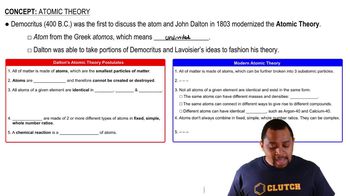
    Democritus first discussed the concept of the atom around 400 BC.
  • What does the Greek word 'Adamus' mean?

    'Adamus' means undivided.
  • Who formulated the five postulates of atomic theory in 1803?

    John Dalton formulated the five postulates of atomic theory in 1803.
  • According to Dalton, what is all matter composed of?

    Dalton stated that all matter is composed of atoms.
  • How does modern atomic theory differ from Dalton's view of the atom's structure?

    Modern atomic theory recognizes three subatomic particles: protons, neutrons, and electrons, while Dalton thought atoms were indivisible.
  • What did Dalton's second postulate state about atoms?

    Dalton's second postulate stated that atoms are indivisible and cannot be created or destroyed.
  • What modern scientific law is similar to Dalton's second postulate?

    Dalton's second postulate is similar to the law of conservation of mass.
  • What did Dalton believe about atoms of a given element?

    Dalton believed all atoms of a given element are identical in mass, size, and properties.
  • Why do modern chemists disagree with Dalton's third postulate?

    Modern chemists recognize isotopes, which are atoms of the same element with different masses.
  • What is an isotope?

    An isotope is an atom of the same element with the same number of protons but a different number of neutrons, resulting in different masses.
  • What did Dalton's fourth postulate state about compounds?

    Dalton's fourth postulate stated that compounds are made of atoms in fixed, simple whole number ratios.
  • How does modern chemistry challenge Dalton's fourth postulate?

    Modern chemistry acknowledges that atoms can combine in more complex ratios, as seen in molecules like glucose.
  • What did Dalton say about chemical reactions in his fifth postulate?

    Dalton said that chemical reactions are rearrangements of atoms.
  • Which of Dalton's postulates are still accepted by modern chemists?

    Modern chemists still accept that matter is composed of atoms and that chemical reactions are rearrangements of atoms.
  • How did Dalton's atomic theory contribute to modern science?

    Dalton's atomic theory laid the groundwork for modern atomic theory, despite some inaccuracies.