Skip to main content
GOB Chemistry
My Course
Learn
Exam Prep
AI Tutor
Study Guides
Textbook Solutions
Flashcards
Explore
Try the app
My Course
Learn
Exam Prep
AI Tutor
Study Guides
Textbook Solutions
Flashcards
Explore
Try the app
Back
Electron Capture & Positron Emission definitions
You can tap to flip the card.
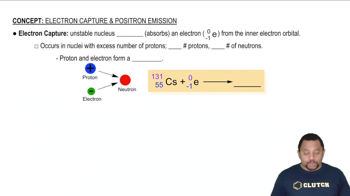
Electron Capture
You can tap to flip the card.
👆
Electron Capture
Absorption of an electron by an unstable nucleus, resulting in a decrease of the atomic number by one.
Track progress
Control buttons has been changed to "navigation" mode.
1/15
Related flashcards
Related practice
Recommended videos
Electron Capture & Positron Emission quiz
Electron Capture & Positron Emission
15 Terms
Electron Capture & Positron Emission
11. Nuclear Chemistry
4 problems
Topic
Jules
Radioactive Half-Life
11. Nuclear Chemistry
5 problems
Topic
Jules
11. Nuclear Chemistry - Part 1 of 2
4 topics
9 problems
Chapter
Jules
11. Nuclear Chemistry - Part 2 of 2
4 topics
9 problems
Chapter
Jules
Guided course
01:53
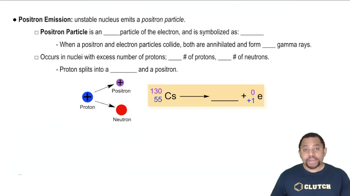
Positron Emission
3889
views
6
rank
Guided course
01:26
Electron Capture
3650
views
3
rank
Guided course
03:29
Electron Capture & Positron Emission Reaction Example
82
views
4
rank
Terms in this set (15)
Hide definitions
Electron Capture
Absorption of an electron by an unstable nucleus, resulting in a decrease of the atomic number by one.
Beta Particle
Subatomic particle identical to an electron, often involved in nuclear reactions such as decay or capture.
Reactant
Substance present at the start of a chemical or nuclear reaction, such as the electron in electron capture.
Product
Substance formed as a result of a chemical or nuclear reaction, like the new element after electron capture.
Beta Decay
Nuclear process where a beta particle is emitted, increasing the atomic number by one.
Emission
Release of a particle from a nucleus, as seen in beta decay where an electron is produced.
Absorption
Process where a nucleus takes in a particle, such as an electron during electron capture.
Isotope
Variant of an element with the same number of protons but different numbers of neutrons, like Fr-223.
Atomic Number
Number representing the count of protons in an atom's nucleus, determining the element's identity.
Nucleus
Central part of an atom containing protons and neutrons, site of nuclear reactions like electron capture.
Francium-223
Radioactive isotope with atomic number 87, used as an example in electron capture reactions.
Radon
Element with atomic number 86, formed when francium-223 undergoes electron capture.
Balanced Nuclear Equation
Representation showing conservation of mass and charge during nuclear reactions, such as electron capture.
Rutherfordium
Element with atomic number 104, named after a physicist, used in examples of electron capture.
Nobelium
Element with atomic number 102, named after Alfred Nobel, featured in electron capture examples.
 BackBack
 01:53
01:53