Skip to main content
GOB Chemistry
My Course
Learn
Exam Prep
AI Tutor
Study Guides
Textbook Solutions
Flashcards
Explore
Try the app
My Course
Learn
Exam Prep
AI Tutor
Study Guides
Textbook Solutions
Flashcards
Explore
Try the app
Back
Factors Affecting Enzyme Activity definitions
You can tap to flip the card.
Enzyme Activity
You can tap to flip the card.
👆
Enzyme Activity
Rate at which a catalyst converts substrate to product, influenced by substrate, enzyme levels, temperature, and pH.
Track progress
Control buttons has been changed to "navigation" mode.
1/13
Related flashcards
Related practice
Recommended videos
Factors Affecting Enzyme Activity quiz
Factors Affecting Enzyme Activity
15 Terms
Factors Affecting Enzyme Activity
19. Enzymes
7 problems
Topic
Laura
Enzyme Inhibition
19. Enzymes
7 problems
Topic
Laura
19. Enzymes
9 topics
15 problems
Chapter
Laura
Guided course
5:33
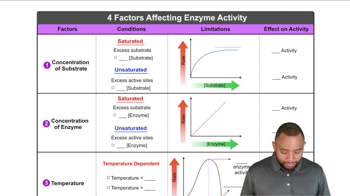
Factors Affecting Enzyme Activity Concept 2
2008
views
2
rank
Guided course
1:06
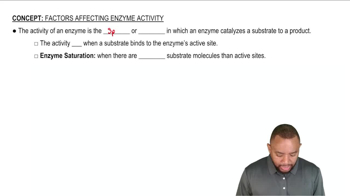
Factors Affecting Enzyme Activity Concept 1
1952
views
2
rank
Guided course
1:31
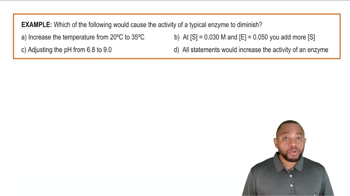
Factors Affecting Enzyme Activity Example 1
1919
views
1
rank
Terms in this set (13)
Hide definitions
Enzyme Activity
Rate at which a catalyst converts substrate to product, influenced by substrate, enzyme levels, temperature, and pH.
Active Site
Specific region on a catalyst where substrate molecules bind, enabling the conversion to product.
Substrate Concentration
Amount of reactant available for binding, affecting the speed of product formation until all sites are occupied.
Enzyme Concentration
Quantity of catalyst present, determining the number of available binding regions for reactants.
Saturation
Condition where all binding regions are occupied, so adding more reactant does not increase conversion speed.
Unsaturated Condition
State where not all binding regions are filled, allowing increased reactant to boost conversion speed.
Optimal Temperature
Specific heat level where a catalyst functions at maximum efficiency, often around 37°C for many biological catalysts.
Denaturation
Loss of three-dimensional structure, causing a catalyst to lose its ability to function properly.
Optimal pH
Specific acidity or alkalinity range where a catalyst operates most efficiently, varying by type.
Physiological pH
Acidity level near 7.4, typical for most biological systems, where many catalysts show peak efficiency.
Pepsin
Catalyst in the stomach with peak efficiency in highly acidic environments, optimal near pH 1.7.
Amylase
Catalyst in the mouth, functioning best in nearly neutral environments, optimal near pH 6.8.
Arginase
Catalyst with peak efficiency in basic environments, optimal near pH 9.4.
 BackBack
 5:33
5:33