Skip to main content
GOB Chemistry
My Course
Learn
Exam Prep
AI Tutor
Study Guides
Textbook Solutions
Flashcards
Explore
Try the app
My Course
Learn
Exam Prep
AI Tutor
Study Guides
Textbook Solutions
Flashcards
Explore
Try the app
Back
Gluconeogenesis definitions
You can tap to flip the card.
Gluconeogenesis
You can tap to flip the card.
👆
Gluconeogenesis
Metabolic pathway converting pyruvate to glucose through 11 reactions, with four steps distinct from glycolysis.
Track progress
Control buttons has been changed to "navigation" mode.
1/15
Related flashcards
Related practice
Recommended videos
Gluconeogenesis quiz
Gluconeogenesis
15 Terms
Gluconeogenesis
22. Carbohydrate Metabolism
5 problems
Topic
Nicole
Intro to Gluconeogenesis
22. Carbohydrate Metabolism
2 problems
Topic
Nicole
22. Carbohydrate Metabolism
9 topics
15 problems
Chapter
Nicole
Guided course
1:13
Gluconeogenesis Concept 3
1876
views
Guided course
2:01
Gluconeogenesis Example 5
1812
views
Guided course
1:12
Gluconeogenesis Concept 5
1882
views
Terms in this set (15)
Hide definitions
Gluconeogenesis
Metabolic pathway converting pyruvate to glucose through 11 reactions, with four steps distinct from glycolysis.
Pyruvate
Three-carbon molecule serving as the starting point for glucose synthesis in gluconeogenesis.
Oxaloacetate
Four-carbon intermediate formed by carboxylation of pyruvate, essential for the first step of gluconeogenesis.
Phosphoenolpyruvate
High-energy intermediate produced from oxaloacetate via decarboxylation and phosphorylation.
Fructose 1,6-bisphosphate
Six-carbon sugar phosphate acting as a key intermediate, split or formed during glycolysis and gluconeogenesis.
Fructose 6-phosphate
Monophosphate sugar formed by dephosphorylation of fructose 1,6-bisphosphate, preceding glucose formation.
Glucose 6-phosphate
Phosphorylated glucose derivative, last intermediate before free glucose is produced in gluconeogenesis.
Pyruvate Carboxylase
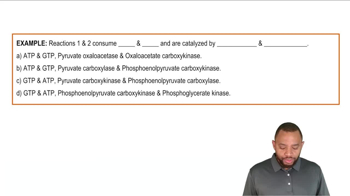
Enzyme catalyzing the addition of carbon dioxide to pyruvate, requiring ATP, to yield oxaloacetate.
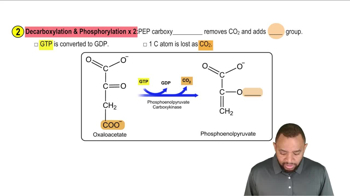
PEP Carboxykinase
Enzyme responsible for converting oxaloacetate to phosphoenolpyruvate, using GTP and releasing CO2.
Fructose 1,6-bisphosphatase
Enzyme removing a phosphate group from fructose 1,6-bisphosphate, forming fructose 6-phosphate.
Glucose 6-phosphatase
Enzyme catalyzing the removal of phosphate from glucose 6-phosphate, yielding free glucose.
ATP
Energy molecule consumed in several steps of gluconeogenesis to drive energetically unfavorable reactions.
GTP
Nucleotide triphosphate used as an energy source specifically in the conversion of oxaloacetate to PEP.
NADH
Electron carrier oxidized during gluconeogenesis, providing reducing power for specific reactions.
Cori Cycle
Metabolic circuit recycling lactate from muscles to liver, where it is converted back to glucose.
 BackBack
 1:13
1:13