Skip to main content
GOB Chemistry
My Course
Learn
Exam Prep
AI Tutor
Study Guides
Textbook Solutions
Flashcards
Explore
Try the app
My Course
Learn
Exam Prep
AI Tutor
Study Guides
Textbook Solutions
Flashcards
Explore
Try the app
Back
Glycerol Metabolism definitions
You can tap to flip the card.
Glycerol
You can tap to flip the card.
👆
Glycerol
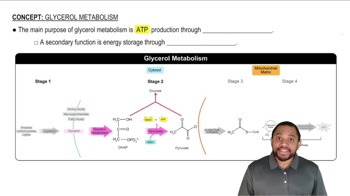
A three-carbon alcohol released from triglyceride hydrolysis, serving as a substrate for energy-yielding metabolic pathways.
Track progress
Control buttons has been changed to "navigation" mode.
1/15
Related flashcards
Related practice
Recommended videos
Glycerol Metabolism quiz
Glycerol Metabolism
15 Terms
Glycerol Metabolism
24. Lipid Metabolism
4 problems
Topic
Nicole
Intro to Fatty Acid Oxidation
24. Lipid Metabolism
2 problems
Topic
Nicole
24. Lipid Metabolism - Part 1 of 2
8 topics
15 problems
Chapter
KeyshawnDavis
24. Lipid Metabolism - Part 2 of 2
1 topic
3 problems
Chapter
Nicole
Guided course
1:20
Glycerol Metabolism Concept 2
1153
views
Guided course
1:14
Glycerol Metabolism Concept 3
1243
views
Guided course
1:30
Glycerol Metabolism Concept 1
1243
views
3
rank
Terms in this set (15)
Hide definitions
Glycerol
A three-carbon alcohol released from triglyceride hydrolysis, serving as a substrate for energy-yielding metabolic pathways.
Triglyceride
A lipid molecule composed of glycerol and three fatty acids, serving as a major energy storage form in cells.
Glycolysis
A cytosolic pathway that converts glucose or intermediates like DHAP into pyruvate, generating ATP.
Gluconeogenesis
A metabolic process that synthesizes glucose from non-carbohydrate precursors such as DHAP, supporting energy storage.
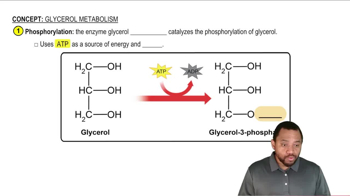
Glycerol Kinase
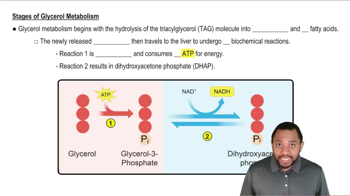
An enzyme that catalyzes the phosphorylation of a three-carbon alcohol, using ATP to produce a phosphorylated intermediate.
Glycerol 3-Phosphate
A phosphorylated intermediate formed from glycerol, serving as a substrate for subsequent oxidation in metabolism.
Glycerol 3-Phosphate Dehydrogenase
An enzyme that oxidizes a phosphorylated three-carbon compound, reducing NAD+ to NADH and forming DHAP.
Dihydroxyacetone Phosphate
A glycolytic intermediate produced from glycerol metabolism, capable of entering glycolysis or gluconeogenesis.
ATP
A high-energy molecule providing phosphate groups and energy for phosphorylation reactions in metabolic pathways.
NAD+
An oxidizing coenzyme that accepts electrons during metabolic reactions, becoming reduced to an energy-carrying form.
NADH
A reduced coenzyme generated during oxidation reactions, carrying electrons for ATP production in cellular respiration.
Phosphorylation
A chemical process involving the addition of a phosphate group to a molecule, often mediated by kinases and requiring ATP.
Oxidation
A reaction involving the loss of electrons or hydrogen from a molecule, commonly facilitated by dehydrogenase enzymes.
Cytosol
The aqueous component of the cell where glycolysis and initial steps of glycerol metabolism occur.
Hydrolysis
A chemical reaction that breaks bonds in molecules like triglycerides, releasing smaller components such as glycerol.
 BackBack
 1:20
1:20