Skip to main content
GOB Chemistry
My Course
Learn
Exam Prep
AI Tutor
Study Guides
Textbook Solutions
Flashcards
Explore
Try the app
My Course
Learn
Exam Prep
AI Tutor
Study Guides
Textbook Solutions
Flashcards
Explore
Try the app
Back
Glycolysis Regulation definitions
You can tap to flip the card.
Glycolysis
You can tap to flip the card.
👆
Glycolysis
A metabolic pathway converting glucose to pyruvate, producing ATP and regulated at key irreversible steps for energy control.
Track progress
Control buttons has been changed to "navigation" mode.
1/15
Related flashcards
Related practice
Recommended videos
Glycolysis Regulation quiz
Glycolysis Regulation
15 Terms
Glycolysis Regulation
22. Carbohydrate Metabolism
Topic
Glycolysis Summary
22. Carbohydrate Metabolism
5 problems
Topic
Laura
22. Carbohydrate Metabolism
9 topics
15 problems
Chapter
Nicole
Guided course
1:35
Introduction to Glycolysis Regulation Concept 1
75
views
Guided course
1:05
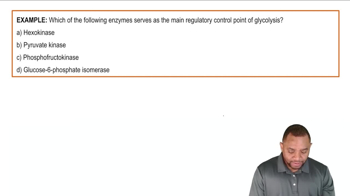
Glycolysis Regulation Example 1
69
views
Guided course
3:39
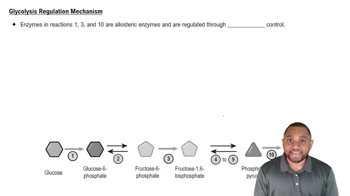
Glycolysis Regulation Mechanism Concept 2
94
views
Terms in this set (15)
Hide definitions
Glycolysis
A metabolic pathway converting glucose to pyruvate, producing ATP and regulated at key irreversible steps for energy control.
ATP
A molecule serving as the main energy currency in cells, whose concentration determines the rate of glycolysis.
Pyruvate
The end product of glycolysis, its formation is tightly regulated to match cellular energy needs.
Allosteric Enzyme
A protein whose activity is modulated by molecules binding at sites other than the active site, crucial for pathway regulation.
Phosphofructokinase
The main regulatory enzyme in glycolysis, acting as the primary control point and responding to ATP, ADP, and AMP levels.
Hexokinase
An enzyme catalyzing the first step of glycolysis, subject to inhibition by its product to prevent excess metabolite buildup.
Pyruvate Kinase
An enzyme catalyzing the final step of glycolysis, its activity is reduced when ATP is abundant to slow pyruvate production.
Irreversible Reaction
A step in glycolysis proceeding in one direction, serving as a key regulatory point due to its commitment to pathway flow.
Feedback Control
A regulatory mechanism where pathway products or intermediates modulate enzyme activity to maintain metabolic balance.
Glucose-6-Phosphate
A glycolytic intermediate that can enter other pathways and inhibits hexokinase to prevent unnecessary glucose phosphorylation.
Fructose-1,6-Bisphosphate
A committed glycolytic intermediate formed at the main regulatory step, signaling the pathway's progression toward pyruvate.
Energy Homeostasis
The cellular state achieved by adjusting metabolic pathway rates to balance ATP production and consumption.
Product Intermediate
A molecule formed during glycolysis that can influence enzyme activity and pathway regulation.
AMP
A molecule indicating low cellular energy, which activates glycolytic enzymes to increase ATP production.
ADP
A molecule signaling energy demand, which stimulates glycolytic regulation to enhance ATP synthesis.
 BackBack
 1:35
1:35