Back

Glycolysis Regulation quiz

Control buttons has been changed to "navigation" mode.
1/15
  • What is the main purpose of glycolysis regulation in cells?

    Glycolysis regulation controls the production of ATP and pyruvate to meet the cell's energy needs. It ensures efficient energy metabolism by adjusting glycolysis speed based on ATP levels and intermediates.
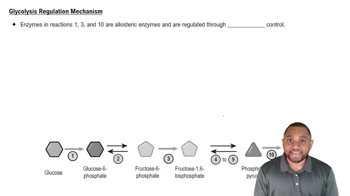
  • Which steps of glycolysis are considered irreversible and regulated allosterically?

    Steps 1, 3, and 10 are irreversible and are regulated by allosteric enzymes. These steps are catalyzed by hexokinase, phosphofructokinase (PFK), and pyruvate kinase (PK), respectively.
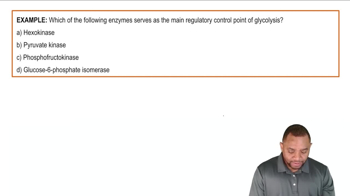
  • Which enzyme acts as the main control point in glycolysis regulation?

    Phosphofructokinase (PFK) at step 3 is the main control point. It commits glucose to glycolysis by producing fructose 1,6-bisphosphate.
  • How does high ATP concentration affect phosphofructokinase (PFK) activity?

    High ATP inhibits PFK, slowing down glycolysis. This prevents unnecessary ATP production when energy is sufficient.
  • What effect do ADP and AMP have on PFK activity?

    ADP and AMP activate PFK, increasing glycolysis. Their presence signals low ATP, prompting the cell to make more ATP.
  • Why is step 3, not step 1, considered the main control point of glycolysis?

    Step 3 commits glucose to glycolysis, while the product of step 1 (glucose-6-phosphate) can enter other pathways. Therefore, regulation at step 3 is more effective for controlling glycolysis.
  • What enzyme catalyzes the first step of glycolysis and how is it regulated?

    Hexokinase catalyzes the first step and is inhibited by its product, glucose-6-phosphate. This prevents excess accumulation of glucose-6-phosphate.
  • How does high ATP concentration affect pyruvate kinase (PK) activity?

    High ATP inhibits pyruvate kinase, slowing the production of pyruvate. This helps prevent overproduction of ATP and pyruvate.
  • What is the role of feedback control in glycolysis regulation?

    Feedback control adjusts enzyme activity based on ATP and product levels. It ensures glycolysis operates efficiently according to cellular needs.
  • Which glycolytic intermediate can be used in pathways other than glycolysis?

    Glucose-6-phosphate can be used in glycogen synthesis, fatty acid synthesis, and other biochemical pathways. This is why its regulation is not the main control point.
  • What happens to glycolysis speed when cellular ATP is low?

    Glycolysis speeds up when ATP is low. This increases ATP production to meet cellular energy demands.
  • What is the effect of glucose-6-phosphate accumulation on hexokinase?

    Accumulation of glucose-6-phosphate inhibits hexokinase. This slows glycolysis to prevent excess glucose-6-phosphate buildup.
  • How do allosteric enzymes contribute to glycolysis regulation?

    Allosteric enzymes respond to ATP and product intermediates to regulate glycolysis speed. They ensure the pathway matches the cell's metabolic needs.
  • Which steps of glycolysis are reversible, and how are they represented in diagrams?

    Steps 2 and 4-9 are reversible and are shown with double arrows in diagrams. These steps can proceed in both directions depending on cellular conditions.
  • Why is it important for glycolysis to be regulated at multiple steps?

    Regulation at multiple steps allows fine-tuned control of energy production and metabolite flow. It prevents wasteful overproduction and ensures metabolic balance.