Skip to main content
GOB Chemistry
My Course
Learn
Exam Prep
AI Tutor
Study Guides
Textbook Solutions
Flashcards
Explore
Try the app
My Course
Learn
Exam Prep
AI Tutor
Study Guides
Textbook Solutions
Flashcards
Explore
Try the app
Back
Glycolysis definitions
You can tap to flip the card.
Glycolysis
You can tap to flip the card.
👆
Glycolysis
A ten-step metabolic pathway that splits glucose into two pyruvate molecules, producing ATP and NADH in the process.
Track progress
Control buttons has been changed to "navigation" mode.
1/15
Related flashcards
Related practice
Recommended videos
Glycolysis quiz
Glycolysis
15 Terms
Glycolysis
22. Carbohydrate Metabolism
7 problems
Topic
Laura
Glycolysis Regulation
22. Carbohydrate Metabolism
Topic
22. Carbohydrate Metabolism
9 topics
15 problems
Chapter
Nicole
Guided course
1:18
Glycolysis Concept 3
2417
views
1
rank
Guided course
1:27
Glycolysis Example 2
2394
views
2
rank
Guided course
1:46
Glycolysis Example 3
2347
views
1
rank
Terms in this set (15)
Hide definitions
Glycolysis
A ten-step metabolic pathway that splits glucose into two pyruvate molecules, producing ATP and NADH in the process.
Phase A
The energy-consuming first half of glycolysis, converting glucose into two Glyceraldehyde 3-Phosphate molecules.
Phase B
The energy-producing second half of glycolysis, generating ATP, NADH, and pyruvate from Glyceraldehyde 3-Phosphate.
Hexokinase
An enzyme that catalyzes the phosphorylation of glucose, using ATP to add a phosphate group.
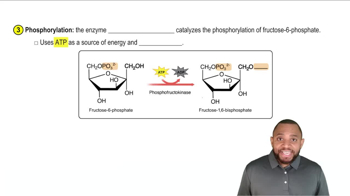
Phosphofructokinase
A key regulatory enzyme that adds a second phosphate to fructose 6-phosphate, committing it to glycolysis.
Aldolase
An enzyme that cleaves fructose 1,6-bisphosphate into two three-carbon sugars during glycolysis.
Isomerase
A class of enzymes that rearrange molecular structures without changing the molecular formula.
Dehydrogenase
A class of enzymes responsible for oxidation reactions, transferring electrons to NAD+ to form NADH.
Mutase
A type of isomerase that shifts functional groups, such as phosphates, within a molecule.
Pyruvate
The three-carbon end product of glycolysis, formed after the final phosphate transfer.
ATP
A high-energy molecule produced and consumed during glycolysis, serving as the cell's main energy currency.
NADH
An electron carrier generated during glycolysis, storing energy for later use in cellular respiration.
Phosphoenolpyruvate
A high-energy intermediate in glycolysis, donating its phosphate to ADP to form ATP and pyruvate.
Fructose 1,6-Bisphosphate
A six-carbon sugar with two phosphate groups, formed after the second phosphorylation in glycolysis.
Glyceraldehyde 3-Phosphate
A three-carbon sugar phosphate produced in phase A, serving as the substrate for energy extraction in phase B.
 BackBack
 1:18
1:18