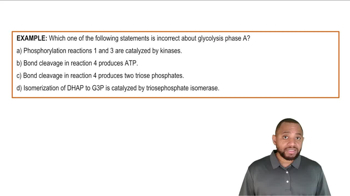
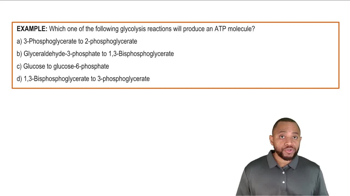
What are the two phases of glycolysis called and what is their main function?
Phase A is the energy consuming phase, converting glucose to 2 G3P; Phase B is the energy producing phase, converting 2 G3P to 2 pyruvates and producing ATP and NADH.
Which enzyme catalyzes the phosphorylation of glucose in reaction 1 of glycolysis?
Hexokinase catalyzes the phosphorylation of glucose to glucose 6-phosphate using ATP.
What type of reaction is catalyzed by phosphoglucoisomerase in glycolysis?
Phosphoglucoisomerase catalyzes an isomerization reaction, converting glucose 6-phosphate to fructose 6-phosphate.
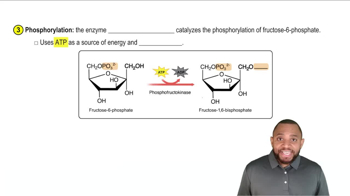
Which enzyme is responsible for the phosphorylation of fructose 6-phosphate in reaction 3?
Phosphofructokinase catalyzes the phosphorylation of fructose 6-phosphate to fructose 1,6-bisphosphate using ATP.
What is the product of the cleavage of fructose 1,6-bisphosphate by aldolase?
Aldolase cleaves fructose 1,6-bisphosphate into dihydroxyacetone phosphate (DHAP) and glyceraldehyde 3-phosphate (G3P).
What is the significance of the isomerization between DHAP and G3P in glycolysis?
The isomerization allows DHAP to be converted to G3P, ensuring both molecules can proceed through the energy-producing phase.
How many ATP molecules are consumed during Phase A of glycolysis?
Two ATP molecules are consumed during Phase A, one in reaction 1 and one in reaction 3.
What is the main product of Phase B of glycolysis?
Phase B produces 2 pyruvate molecules, 2 NADH, and 4 ATP from 2 G3P molecules.
Which enzyme catalyzes the oxidation of G3P in reaction 6, and what is produced?
Glyceraldehyde 3-phosphate dehydrogenase catalyzes the oxidation of G3P, producing 1,3-bisphosphoglycerate and NADH.
What happens during reaction 7 of glycolysis, and which enzyme is involved?
Phosphoglycerate kinase transfers a phosphate from 1,3-bisphosphoglycerate to ADP, producing ATP and 3-phosphoglycerate.
What is the role of phosphoglycerate mutase in glycolysis?
Phosphoglycerate mutase catalyzes the isomerization of 3-phosphoglycerate to 2-phosphoglycerate by moving the phosphate group.
Which enzyme catalyzes the dehydration of 2-phosphoglycerate, and what is the product?
Enolase catalyzes the dehydration of 2-phosphoglycerate, producing phosphoenolpyruvate (PEP).
What is the final step of glycolysis and which enzyme catalyzes it?
The final step is the transfer of phosphate from PEP to ADP, forming ATP and pyruvate, catalyzed by pyruvate kinase.
How many NADH and ATP molecules are produced in Phase B of glycolysis?
Phase B produces 2 NADH and 4 ATP molecules from the conversion of 2 G3P to 2 pyruvate.
What types of enzymes are involved in glycolysis and what are their functions?
Kinases transfer phosphate groups, isomerases rearrange molecular structures, dehydrogenases catalyze oxidation, and mutases shift chemical groups.
 Back
Back
 1:18
1:18