Back

Rutherford Gold Foil Experiment definitions

Control buttons has been changed to "navigation" mode.
1/15
  • Nucleus

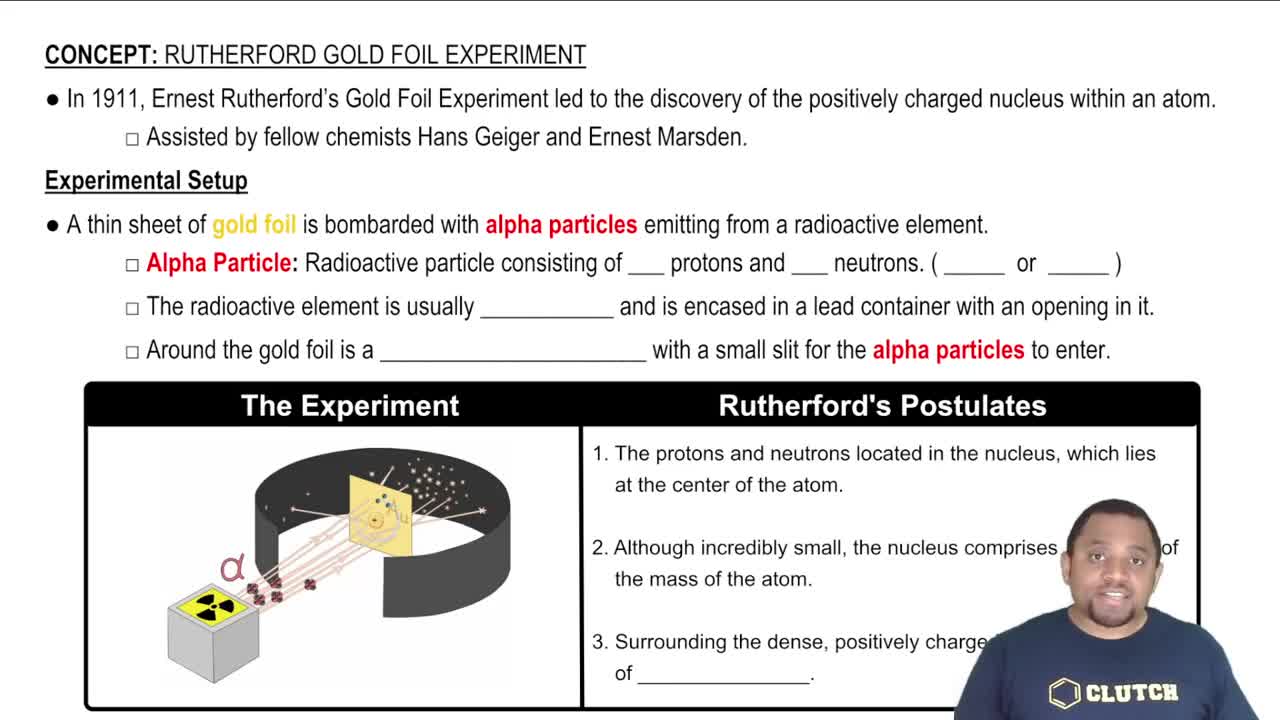
    Dense, positively charged center of an atom containing most of its mass, composed of protons and neutrons.
  • Alpha Particle

    Radioactive particle with 2 protons and 2 neutrons, symbolized as 4/2 He 2+, used to probe atomic structure.
  • Gold Foil

    Thin metallic sheet used as a target for alpha particles to reveal atomic structure in a landmark experiment.
  • Detecting Screen

    Instrument surrounding the target, used to observe the paths and deflections of incoming alpha particles.
  • Radioactive Source

    Material, often iridium, emitting alpha particles for experimental bombardment of the gold foil.
  • Lead Container

    Shielding enclosure with a slit, directing alpha particles toward the gold foil while containing radiation.
  • Proton

    Positively charged subatomic particle found in the nucleus, contributing to atomic mass and charge.
  • Neutron

    Neutral subatomic particle located in the nucleus, adding to atomic mass but not charge.
  • Electron

    Negatively charged subatomic particle found in a cloud surrounding the nucleus of an atom.
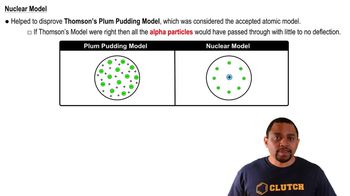
  • Nuclear Model

    Atomic structure concept with a dense central nucleus and electrons in surrounding space, replacing earlier models.
  • Plum Pudding Model

    Earlier atomic theory proposing electrons embedded in a positively charged sphere, later disproven.
  • Deflection

    Change in trajectory of alpha particles upon encountering a dense atomic center, indicating a nucleus.
  • Geiger Marsden Experiment

    Alternate name for the gold foil experiment, recognizing the contributions of Rutherford's assistants.
  • Atomic Mass

    Majority of this property is concentrated in the nucleus, as revealed by the gold foil experiment.
  • Postulate

    Foundational statement derived from experimental results, shaping the understanding of atomic structure.