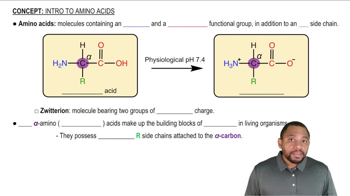
A functional group containing nitrogen, typically bonded to two hydrogens, that can gain a proton to become positively charged at physiological pH.
Carboxyl Group
A functional group composed of a carbon double-bonded to oxygen and single-bonded to a hydroxyl, which loses a proton to become negatively charged at physiological pH.
Alpha Carbon
The central atom in an amino acid structure, bonded to an amino group, a carboxyl group, a hydrogen atom, and an R group.
R Group
A variable side chain attached to the alpha carbon, responsible for the unique properties of each amino acid.
Zwitterion
A molecular form with both a positively charged amino group and a negatively charged carboxylate group, common at physiological pH.
Carboxylate Anion
A negatively charged form of the carboxyl group, resulting from the loss of a proton in a slightly basic environment.
Physiological pH
A pH value of about 7.4, typical of living organisms, where amino acids commonly exist in their zwitterion form.
Standard Amino Acids
The set of 20 alpha amino acids found in proteins, each with a distinct R group.
Protein
A biological macromolecule constructed from chains of amino acids, essential for structure and function in living organisms.
Hydrogen Atom
A single proton with one electron, bonded to the alpha carbon in every amino acid.
Functional Group
A specific group of atoms within a molecule that imparts characteristic chemical properties, such as amino or carboxyl groups.
Alpha Amino Acid
A molecule featuring an amino group, a carboxyl group, a hydrogen, and an R group all attached to a central alpha carbon.
Nitrogen
An element present in the amino group, capable of forming four bonds and carrying a positive charge when fully bonded.
 Back
Back

 2:11
2:11