Back

Intro to DNA Replication quiz

Control buttons has been changed to "navigation" mode.
1/15
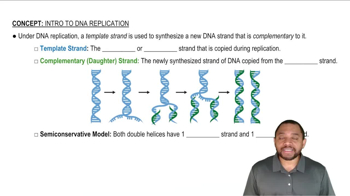
  • What is the template strand in DNA replication?

    The template strand is the original or parent DNA strand that is copied during replication to synthesize a new complementary strand.
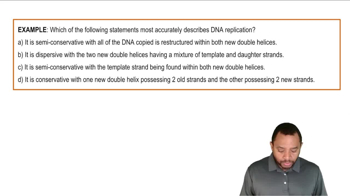
  • What does the semiconservative model of DNA replication state?

    It states that each new DNA double helix contains one old (template) strand and one newly synthesized (daughter) strand.
  • Which enzyme unwinds the DNA double helix during replication?

    Helicase unwinds the DNA double helix by breaking hydrogen bonds between nitrogenous bases.
  • What is the function of stabilizing proteins in DNA replication?

    Stabilizing proteins bind to and stabilize single-stranded DNA, keeping the strands apart so replication can occur.
  • What does primase do during DNA replication?

    Primase synthesizes short RNA primers that provide a starting point for DNA synthesis.
  • What is the role of DNA polymerase in DNA replication?

    DNA polymerase synthesizes new DNA strands by adding nucleotides complementary to the template strand.
  • How does DNA ligase contribute to DNA replication?

    DNA ligase joins together fragments of newly synthesized DNA, sealing gaps to create a continuous strand.
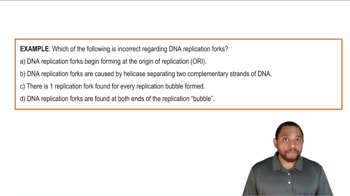
  • Where does DNA replication begin on the DNA molecule?

    DNA replication begins at specific sites called origins of replication.
  • What is a replication fork?

    A replication fork is a Y-shaped region where the DNA is unwound and new strands are being synthesized.
  • How does DNA replication proceed from the origin of replication?

    DNA replication proceeds bidirectionally, forming two replication forks that move in opposite directions.
  • How is the leading strand synthesized during DNA replication?

    The leading strand is synthesized continuously in the same direction as the replication fork movement, requiring only one RNA primer.
  • How is the lagging strand synthesized during DNA replication?

    The lagging strand is synthesized discontinuously in the opposite direction of the replication fork, forming short DNA segments called Okazaki fragments.
  • What are Okazaki fragments?

    Okazaki fragments are short segments of newly synthesized DNA on the lagging strand, each starting with a new RNA primer.
  • Why are multiple RNA primers needed on the lagging strand?

    Multiple RNA primers are needed because the lagging strand is synthesized in short fragments, each requiring a new primer to start DNA synthesis.
  • How are gaps between Okazaki fragments joined together?

    DNA ligase joins the gaps between Okazaki fragments to form a continuous DNA strand.